


Imagine a colossal pillar of rock erupting 660 feet from the jungle floor. Now, picture the ruins of a magnificent palace perched on its flat top. This isn’t a scene from a fantasy novel—this is Sigiriya, Sri Lanka’s breathtaking ‘Lion Rock.’ But how, and why, did an ancient king decide to build his kingdom in the sky? Read the Best info about private sigiriya tour.
Most visitors see a stunning natural landmark, but they are actually looking at what was essentially a fortress born from royal betrayal. According to historical chronicles, the entire Lion Rock fortress was built out of fear by a king who seized the throne. Now a UNESCO World Heritage site, its story is as dramatic as its appearance.
A Sigiriya tour is a journey through this story. It begins on the ground in some of the world’s oldest landscaped gardens. The ascent then takes you past stunning ancient frescoes and through the gigantic Lion’s Paws that guard the final climb. Your reward at the summit is not just the 360-degree view, but a walk among the ruins of the sky palace itself.
This guide covers the key sights, the fascinating history, and the practical tips you need to plan your own unforgettable ascent.
The King in the Sky: Why Was Sigiriya Built?
So, why would anyone build a palace on top of a massive rock? The history of the Lion Rock fortress is pure family drama. In the 5th century, a king named Kashyapa took the throne from his own father. Fearing his exiled brother would one day return for revenge, King Kashyapa abandoned the traditional capital and sought a location that was both magnificent and untouchable. He found his answer in this colossal stone pillar, choosing it as the site for his new, secure kingdom.
Sigiriya was therefore designed to be two things at once: an opulent palace and an impenetrable stronghold. On one hand, it was a lavish home filled with stunning art, landscaped gardens, and shimmering pools meant to showcase the king’s power and taste. On the other, its sheer cliffs and 360-degree view of the surrounding jungle made it a defender’s dream. It was the ultimate ancient penthouse, offering unparalleled luxury with a world-class security system built right in.
This dramatic history transforms your visit from a simple hike into a journey through history. As you ascend, you’re not just climbing steps; you’re walking through the ambitions and fears of King Kashyapa. Every terrace, wall, and garden was part of his grand vision for a palace in the sky. Your tour through this remarkable piece of Sri Lankan history begins where his court’s would have: at the very bottom.
Your First Wonder: Exploring the Royal Water Gardens
Long before you begin the famous climb, your journey into King Kashyapa’s world starts on the ground. The path to the rock fortress isn’t just a dusty trail; it’s a grand entrance through the sprawling Royal Gardens. The most striking section is the Water Gardens, a beautiful and symmetrical network of pools, moats, and pathways. You’re immediately shown that this place was designed as much for pleasure as it was for protection, setting a serene tone for the adventure ahead.
What’s truly astonishing here is the engineering. These gardens feature one of the world’s oldest examples of ancient hydraulic systems. A complex underground network of channels once fed the shimmering fountains and bathing pools. Even today, over 1,500 years later, some of these fountains can bubble to life during the rainy season—a testament to the incredible ingenuity of their creators. It’s a powerful reminder that you are walking through the remains of a highly advanced civilization.
Beyond the formal water features, the landscape transitions into the Boulder Gardens, where pathways wind around giant, naturally fallen rocks that were incorporated into the design. From there, you’ll encounter the Terraced Gardens, which rise in steps up the slope of Sigiriya itself. This carefully designed progression from manicured pools to wild boulders and finally to structured terraces was all part of the experience, preparing ancient visitors for the main event. Now, your own ascent begins.
A Glimpse of an Ancient World: The Sigiriya Frescoes and Mirror Wall
As you make your way up the side of the rock, the path leads to a sheltered gallery that holds some of Sigiriya’s greatest treasures. Here, protected from the elements, you’ll find the famous Sigiriya Frescoes. Painted directly onto the rock face over 1,500 years ago, these stunning portraits of women—often called the ‘Celestial Maidens’—are some of the oldest and best-preserved examples of ancient Sri Lankan art. Their identities remain a mystery, but their beauty has captivated visitors for centuries.
Just beyond the frescoes, you will walk alongside a long, highly polished plaster wall. This is the Mirror Wall. It was once so smooth that it’s said the king could see his reflection in it. Over time, however, it took on a new role. Visitors from as early as the 8th century were so moved by the frescoes that they etched their impressions and poems onto the wall’s surface. This collection of ancient graffiti serves as an incredible historical guestbook, sharing the thoughts of people who stood in this very spot more than a thousand years ago.
To protect this fragile heritage, your role as a modern visitor is crucial. The area is delicate, and following a few simple rules ensures this unique site survives.
- No flash photography is allowed, as the intense light can permanently damage the ancient pigments.
- Do not touch the wall or the paintings. The oils and residue from your hands can cause irreversible harm.
- Keep moving along the narrow staircase to allow everyone a chance to see these wonders without causing a bottleneck.
After passing this gallery of ancient art, the path continues upward, preparing you for the final, dramatic approach to the summit.
The Gateway to the Summit: Facing the Lion’s Paws
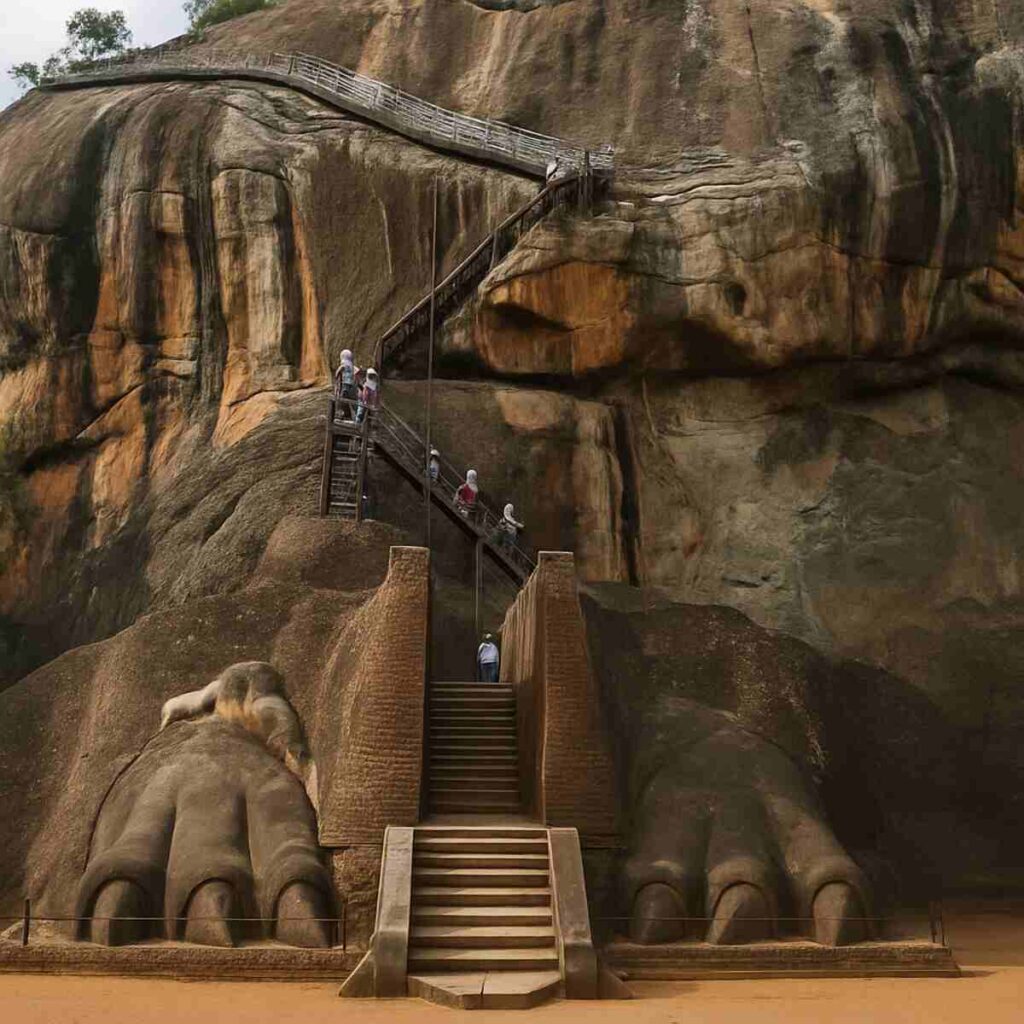
After the enclosed gallery, the path opens onto a wide terrace, giving you a moment to catch your breath. It’s here that you finally come face-to-face with the feature that gives Sigiriya its name: Lion Rock. Guarding the final ascent are two colossal lion’s paws, carved directly from the stone. Their sheer scale is staggering, marking the grand gateway to the palace that once stood far above you on the summit.
Try to imagine what ancient visitors would have seen. Originally, these paws were attached to a massive, sculpted lion’s head and chest, and guests would have had to walk through the lion’s open mouth to continue their ascent. This wasn’t just architecture; it was a powerful statement. The lion was a symbol of royal authority, designed to inspire awe in friends and intimidate any enemies brave enough to have made it this far.
Today, the lion’s head is long gone, replaced by a modern metal staircase that rises steeply between the paws. This is the final and most exposed part of your journey to the top. While the stairs are sturdy, take your time and hold onto the handrails. Your reward for this last push is just moments away: the palace ruins and an unforgettable 360-degree view of the Sri Lankan countryside.
The View from the Top: What’s Left of King Kashyapa’s Palace?
Stepping onto the summit feels like reaching another world. The final step of the staircase rewards you with the prize you’ve been climbing for: a breathtaking, 360-degree panoramic view. From this vantage point nearly 660 feet high, the Sri Lankan countryside unfolds below you as an endless carpet of emerald green jungle, dotted with villages and distant blue hills. Looking directly down, you can see the perfect symmetry of the royal gardens you walked through earlier, now laid out like a giant architectural map. Take a moment to simply soak it in—this is the incredible Sigiriya summit view.
Once you tear your eyes away from the horizon, you’ll realize you are walking through the ruins of King Kashyapa’s palace. Spread across nearly four acres, the flat-topped summit is covered with the foundations of what was once a magnificent complex. These low brick walls outline the grand halls, chambers, and terraces of a palace in the sky. It takes some imagination, but you can trace the layout of the king’s private residence, envisioning a life lived far above the ordinary world, protected by the sheer cliffs on all sides.
Life at the top wasn’t just about defense; it was about luxury. One of the most remarkable features is a large, smooth-sided bathing pool carved directly out of the bedrock. Fed by a sophisticated water system that remains a marvel of ancient engineering, it shows that the king’s fortress was also a place of pleasure and comfort. Standing amidst these ruins raises a practical question for any aspiring visitor: how challenging is the ascent?
Is Climbing Sigiriya Rock Difficult? A Realistic Fitness Guide
This is the big question for many visitors, and the answer is reassuring: for most people with an average fitness level, the climb is challenging but very doable. It’s less like a difficult mountain hike and more like climbing the stairs of a very tall building, but with fascinating stops along the way. You don’t need to be an athlete, but a bit of stamina will make the ascent much more enjoyable.
To put it in perspective, the path has approximately 1,200 steps from the gardens to the summit. The entire visit—climbing up, exploring the top, and descending—usually takes between 1.5 and 2.5 hours. Crucially, the path is broken up by wide terraces and landings where the ancient gardens once stood, giving you plenty of opportunities to catch your breath, drink water, and admire the ever-improving view.
The climb does have two main sections that test your nerve more than your muscles. The first is a narrow, enclosed spiral staircase that leads up to the famous fresco gallery. Later, the final ascent to the summit is via a modern metal staircase attached directly to the rock face. While perfectly safe, this open-air section can feel exposed for those with a strong fear of heights, but it’s a relatively short part of the overall journey.
Ultimately, the experience is a personal journey, not a race. Thousands of visitors of all ages complete the climb, and the sense of accomplishment at the top makes every step worthwhile. To make your ascent as comfortable as possible, however, timing is everything.
When to Go: How to Avoid the Crowds and Heat at Sigiriya
Choosing the right time to visit Sigiriya can completely transform your experience, turning a potentially hot and crowded climb into a memorable adventure. The two biggest challenges you’ll face are the tropical sun and the large tour groups that arrive mid-morning. While the best season to visit this region is generally during the drier months from December to April, the time of day you choose to climb is even more critical for your comfort.
To beat the heat and the masses, you have two golden windows. Sigiriya opens at 6:30 AM and closes at 5:30 PM, with last entry around 5:00 PM. Your best bet is to plan your ascent for one of these times:
- Early Morning: Arrive right at the 6:30 AM opening. You’ll be rewarded with cooler temperatures, soft morning light for photos, and a much quieter path.
- Late Afternoon: Start your climb around 3:30 PM. The worst of the day’s heat will have passed, and you may be able to enjoy a beautiful sunset from the top before descending.
If you want the single best strategy for avoiding crowds at Sigiriya, here it is: visit on a weekday and be at the ticket counter before it opens at 6:30 AM. This puts you ahead of almost all the tour buses, allowing you to experience the site in relative peace. You can be up, down, and on your way to a well-deserved breakfast before the peak rush even begins.
Your Sigiriya Packing List: What to Wear and Bring for the Climb
Packing for Sigiriya is less about expedition gear and more about making smart, simple choices for an active day in the sun. The key is to wear lightweight, breathable clothing that you can move in easily. While the site itself doesn’t have a strict dress code, opting for clothing that covers your shoulders and knees is a sign of respect in Sri Lanka’s cultural heartland. Most importantly, choose your footwear wisely; comfortable walking shoes or sturdy trainers are perfect for navigating the mix of ancient stone steps and modern metal staircases.
To keep your daypack light and effective, focus only on what’s essential. This simple Sigiriya packing list covers everything you’ll need for a comfortable ascent:
- Lightweight, breathable clothing
- Comfortable walking shoes (no open-toed sandals)
- Sunscreen, a wide-brimmed hat, and sunglasses
- Your camera or smartphone for those incredible views
- A large bottle of water
Of all the items on your list, the most critical thing to bring to Sigiriya is your own water. There are no shops or vendors once you pass the ticket counter and begin the climb, so staying hydrated is non-negotiable.
Planning Your Budget and Logistics: Fees, Guides, and Getting There
Handling the logistics for your Sigiriya visit starts with the entrance fee, which is a key part of your day’s budget. The Sigiriya fortress entrance fee for tourists is set to international standards (currently around $35 USD, though it’s best to check official sources for the latest price). While this might seem steep compared to other local attractions, remember that your ticket helps preserve this incredible UNESCO World Heritage site for future generations. This fee gives you access to the entire complex, including the gardens, museum, and the climb to the summit.
Once you have your ticket, you’ll face a common choice: to hire a guide or not. Near the entrance, you will find many licensed guides—official, trained storytellers who can bring the ruins to life. For a place so steeped in drama and history, a good guide can transform your visit from a simple (but strenuous) walk into a captivating narrative. If you prefer to explore at your own pace, however, the path is clearly marked and you can absorb the sights independently. The decision comes down to whether you value historical context or quiet contemplation more.
Getting to the rock fortress itself requires some forward planning, as it’s not located in a major city. Most travelers use either Colombo, Kandy, or Dambulla as their starting point. The journey from Colombo is the longest, often taking around four hours by car, while Kandy is a more manageable two to three hours away. Because of this, many visitors choose to stay in a hotel closer to the site for a night or two, allowing for an early morning start to beat the heat and crowds.
Your transportation options largely depend on your budget and travel style. Hiring a private driver is the most comfortable and direct method, giving you complete flexibility. For a more local and budget-friendly experience, you can take a combination of trains and buses, which usually connect through the nearby town of Habarana, a small but vital transport hub for the region.
Sigiriya vs. Pidurangala: Which Rock Should You Climb?
From the top of Sigiriya, you can’t miss it: another massive rock rising from the plains nearby. This is Pidurangala Rock, and it presents every visitor with a delightful dilemma. While Sigiriya is the main event, a climb up Pidurangala offers what many consider the single best view of Sigiriya itself. It’s the photographer’s dream, providing that postcard-perfect shot of the Lion Rock fortress standing majestically against the horizon, especially at sunrise.
The journey to the top of each rock is also vastly different. Climbing Sigiriya is a structured, historical ascent on metal staircases and stone steps—organized, but often crowded. In contrast, the Pidurangala rock climb is a more natural and adventurous hike. The path winds through a forest, passes a reclining Buddha statue, and culminates in a fun, but moderately challenging, scramble over boulders to reach the bare, expansive summit.
At the top, the experiences diverge completely. Sigiriya’s summit is a fascinating archaeological site, filled with the foundations of King Kashyapa’s palace. You’re walking through history. Pidurangala’s summit, however, is all about the raw, uninterrupted 360-degree panorama. It offers a quieter, more meditative space to simply sit and absorb the incredible landscape. This different experience comes at a much lower cost, as the entrance fee for Pidurangala is a small fraction of Sigiriya’s.
So, which one is right for you? It truly depends on your goal. For history, archaeology, and the prestige of climbing the main landmark, choose Sigiriya. For the ultimate view, a bit of adventure, and a more peaceful experience, choose Pidurangala. Many travelers with a full day even choose to do both—climbing Pidurangala for sunrise and tackling Sigiriya later in the morning.
Beyond the Rock: Creating a Perfect Day Trip to Sigiriya and Dambulla
Capitalizing on your visit to Sigiriya is easy, as another of Sri Lanka’s cultural treasures is just down the road. By combining your climb with a stop at the Dambulla Cave Temple, you can transform your excursion into a full and unforgettable day trip. The two sites are located only 30 minutes apart, making them a perfect pair for travelers looking to experience the heart of Sri Lanka’s Cultural Triangle without spending all their time in transit. This popular combination allows you to soak in two completely different, yet equally significant, historical wonders.
While Sigiriya reaches for the sky, the Dambulla Cave Temple goes deep into the rock. This magnificent UNESCO World Heritage site is a complex of five caves filled with over 150 stunning Buddha statues. As you step from the bright sunlight into the cool, quiet grottos, you’ll discover walls and ceilings covered in vibrant, ancient frescoes that tell stories from the Buddha’s life. It feels less like a ruin and more like a sacred art gallery that has been preserved for thousands of years, offering a peaceful and profound contrast to the adventurous energy of the Lion Rock climb.
For the most comfortable and efficient day, plan to climb Sigiriya first thing in the morning to beat the midday heat and the biggest crowds. After you’ve descended and had a chance to refresh, you can make the short journey to Dambulla for an afternoon of cultural exploration. Just remember a key practical tip: while you’ll want athletic clothes for the climb, Dambulla is an active place of worship. Be sure to have a sarong, scarf, or jacket handy to cover your shoulders and knees before entering the sacred cave complex.
Your Unforgettable Sigiriya Adventure
Sigiriya is more than a mysterious rock fortress on a postcard. It is a story of a dramatic king, ingenious gardens, breathtaking frescoes, and a palace in the sky. It’s an experience that begins with a walk through history and ends with a personal triumph.
The key to a great experience is simple: plan your timing. Decide if you’ll be an early-morning climber catching the sunrise or a late-afternoon adventurer enjoying the cooler air. Go at your own pace, as the journey is not a race, but a chance to absorb the wonder at every level.
A visit to Sigiriya is a climb through time, where each step takes you deeper into an ancient story of ambition and artistry. You’ll arrive at the top not just with incredible photos, but with the profound sense of accomplishment that comes from standing where kings once stood, looking out over a kingdom you now understand.
