


Are your game nights getting bogged down by complicated rules and hour-long setups? The search for fun party card games for groups often ends with someone reading a confusing manual while the snacks get cold. It’s an experience that can drain the energy from any get-together, but there is a perfect antidote. Check out UFAZEED to know more
Enter Pass the Trash. This is the kind of simple card game with one deck that you can teach to a crowd in under five minutes. Forget about needing special equipment or extensive score sheets; if you have a standard deck of 52 cards and a few friends, you have everything required to start playing immediately. The game’s design prioritizes speed, suspense, and laughter over complex strategy.
At its core, the goal is delightfully straightforward: get a hand of three cards as close to 31 points as possible, using only cards of the same suit. On your turn, you have a simple choice to either swap a card with the community pile or take your chances with a fresh card from the deck. These easy rules ensure the game moves quickly, keeping everyone engaged. This guide will help you learn the rules so you can confidently teach it to your friends and lead your next game night.
What You Need to Start Playing (The 2-Minute Setup)
One of the best things about Pass the Trash is that you probably have everything you need for a game right now. There’s no complex board or tiny pieces to track, making it a perfect, low-fuss choice for any get-together.
Here’s your quick checklist:
- A standard 52-card deck (no jokers needed)
- 3 to 13 players
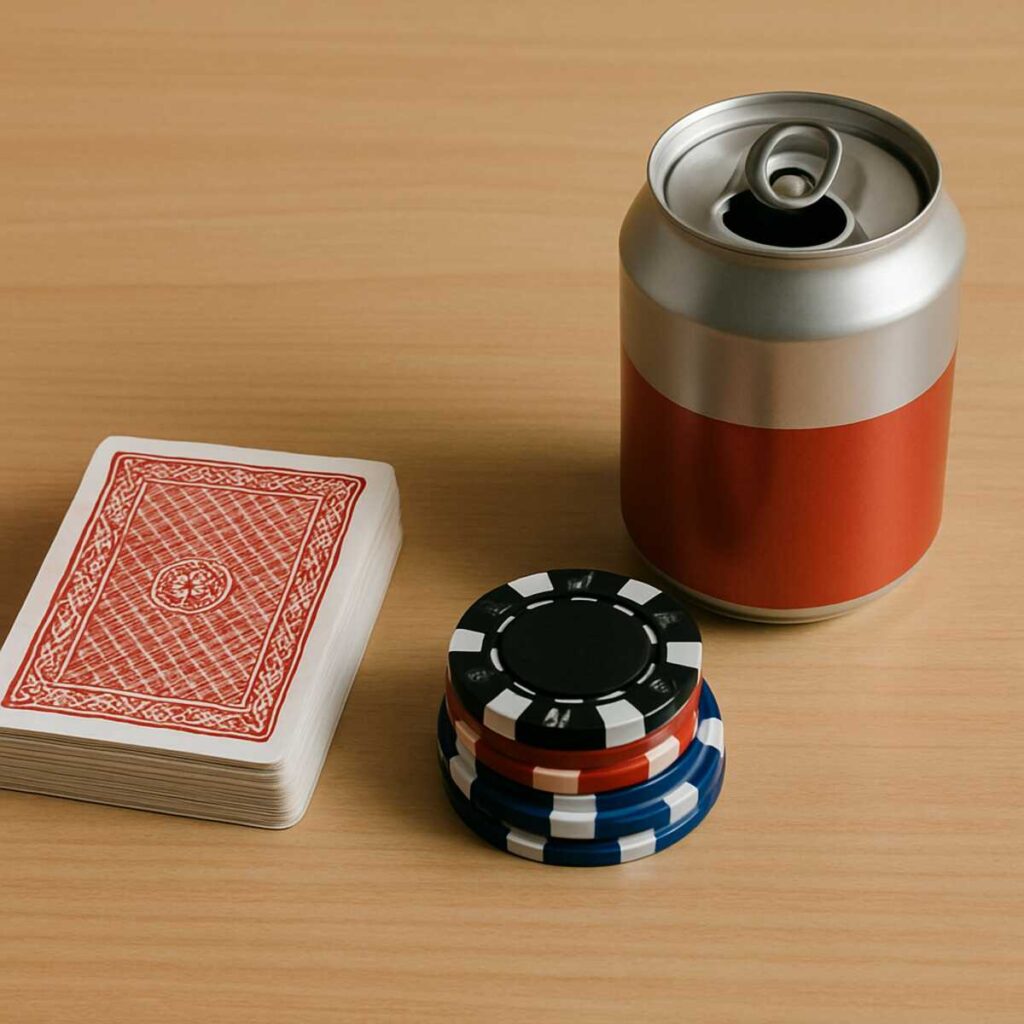
- Three “tokens” for each person
Those tokens are the key—think of them as your “lives,” just like in a video game. You don’t need fancy game pieces; most people just use coins, poker chips, or even wrapped candies. When you run out of tokens, you’re out of the game, so guard them well! The wide player range makes this one of the best card games for large groups and small gatherings alike.
What’s the Goal? How to Get 31 Points in a Single Suit
The objective in the Pass the Trash card game is refreshingly simple: get a hand worth as close to 31 points as possible. At the end of each round, players compare their hands, and whoever has the lowest score must give up one of their tokens. This single, straightforward goal is what makes it one of the best card games with easy rules, focusing all the action on building the best possible hand before time runs out.
Here’s the crucial twist: you can only add up points from cards of the same suit. For example, if you hold the King of Spades (10 points), the 7 of Spades (7 points), and the Queen of Hearts (10 points), your score isn’t 27. You have to choose a suit to count. Your Spades add up to 17, while your lone Heart is worth 10. You always take the higher total, making your score 17 for the round.
Getting exactly 31 points is a special event called a “Blitz” or simply “31.” This is an instant-win hand, like a three-of-a-kind made of an Ace and two face cards of the same suit. If you’re dealt or manage to create a 31, you show it immediately. The round ends, and every other player loses a token. But a perfect hand is rare; most of the game is spent trying to improve your score, one turn at a time.
Step 1: How to Deal the Cards and Set Up the Game
To get started, choose a dealer. The dealer shuffles a standard 52-card deck and deals three cards face-down to each player, one at a time. This initial hand is all you have to work with, so don’t show it to anyone just yet! Your goal is to improve these three cards over the course of the round.
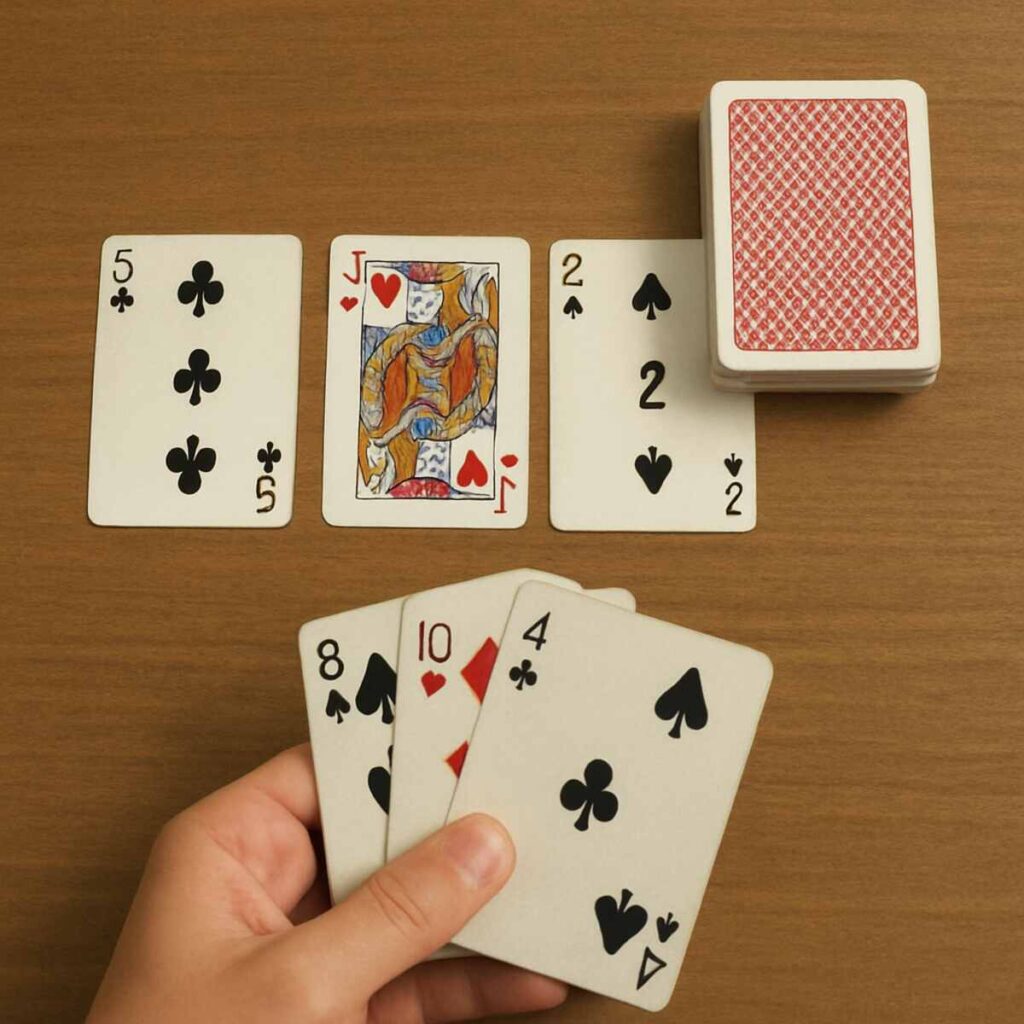
Once everyone has their hand, the dealer places the next three cards from the deck face-up in the center of the table. These cards form the “middle,” sometimes called the “trash pile.” Think of this as a public pool of cards available to everyone. As you can see in the photo below, this setup gives every player a clear view of their potential exchange options right from the start.
The rest of the deck is placed face-down to one side, creating the draw pile. While you will mostly interact with the face-up cards in the middle, this draw pile serves as an alternate, riskier source for new cards.
Step 2: How to Play Your Turn—Your Two Simple Choices
On your turn, your entire goal is to improve the three cards in your hand. The player to the left of the dealer goes first, with play continuing clockwise. When it’s your turn, you have two simple choices: swap with the cards in the middle or take a risk by drawing from the deck.
Your first and most common choice is to swap one of your cards for one of the three face-up cards in the middle. Simply place a card from your hand that you don’t want face-up into the middle, and then take one of the cards from the middle to replace it. This is a straightforward, one-for-one exchange and the safest way to improve your hand because you know exactly what you’re getting.
If you don’t like any of the cards in the middle, your other option is to draw the top card from the face-down deck. Look at it without showing anyone else. You can then choose to either keep this new card (and discard one from your hand into the middle) or discard the new card directly into the middle. This part of how to play the card game Trash introduces a bit of luck, but a great draw can be a simple Pass the Trash strategy to win the round. Deciding whether a swap is good or a draw was worth the risk all comes down to points.
How to Score Your Hand: What Are the Cards Worth?
Remember, the goal is to get as close to 31 points as possible, and you can only add up the values of cards from the same suit. If you have two hearts and a spade in your hand, you can either count the total of your hearts or the total of your spade—you can’t add them all together. This makes collecting cards of a single suit your main mission.
The point values themselves are very straightforward:
- Aces: 11 points (the best card you can get!)
- Kings, Queens, & Jacks: 10 points each. In terms of King Queen Jack card values, they are all equal.
- Numbered Cards (2-10): Their face value (a 7 is worth 7 points, a 4 is worth 4, etc.).
For example, look at the hand shown here. With the Ace of Spades, 10 of Spades, and 5 of Spades, your score is a powerful 26 points (11 + 10 + 5). However, if that 5 of Spades were a 5 of Hearts, your score would only be 21 from your two spades. Once you have a great hand, you can signal the end of the round with a “knock.”
How to End a Round: The Power of the ‘Knock’
Let’s say you’re sitting on a strong hand—maybe 25 points or more. You’re happy with your score and don’t want to risk breaking up your suit by drawing a new card. According to the Pass the Trash rules for beginners, you can end the round on your own terms.
Instead of taking a card, you use your turn to “knock” by rapping your knuckles on the table. A knock is a signal to everyone that you are freezing your hand and are ready for the showdown. You can’t take any more actions in the round after you knock, but you’ve just put all the pressure on your opponents.
The knock immediately triggers the final lap. After you knock, play continues around the table, giving every other player exactly one more turn to improve their hand. This is a core part of the Pass the Trash strategy to win—if you have a confident score, knocking can catch other players off-guard and prevent them from building a better hand.
Once that last player has taken their final turn, the action stops. It’s time for the moment of truth.
The Showdown: Comparing Scores and Losing a Life
Once the final turn is over, the “Showdown” begins. Starting with the player to the dealer’s left, everyone lays their three cards face-up on the table and announces their score. Remember, you’re looking for the player with the lowest total, not the highest. In this Pass the Trash card game, having a strong hand keeps you safe, while a low score puts you in the hot seat.
Once all scores are on the table, the round’s loser is easy to spot. The player holding the weakest hand (the lowest point total) must give up one of their three tokens. Think of these as “lives”—you’ve just lost one, but you’re still in the game. That player simply places one of their tokens into a discard pile in the center.
What happens if there’s a tie for the lowest score? The Pass the Trash rules are simple and a little ruthless: all players tied for last place lose a token. If two players are stuck with 5 points, they both have to surrender a life. This rule is essential to knowing how to play the card game Trash correctly. After the loser has been determined, the deal passes to the next player, and a new round begins.
How Do You Win? Becoming the Last Player Standing
Losing a token stings, but you’re not out yet. The real goal is to protect your tokens round after round. Think of it less as a race to a high score and more as a game of survival. This makes it one of the most engaging fun party card games for groups, as the pressure mounts with every hand.
Eventually, a player will lose their third and final token and is officially eliminated. The game simply continues without them, getting more intense as the circle of players shrinks. The drama of this simple card game with one deck comes from watching your friends get knocked out while you hang on by a thread.
The game ends when only one person has at least one token left. That player is the winner! Ultimately, the best Pass the Trash strategy to win is simply to outlast everyone else. You don’t need the best hand every time; you just need to avoid having the worst.
Two Simple Strategies to Avoid Being the Loser
While luck plays a huge role in Pass the Trash, you aren’t completely helpless. The best Pass the Trash strategy to win isn’t always about getting a perfect hand—it’s about knowing what to do with a decent one. Making smart decisions can dramatically increase your chances of surviving each round.
Your first strategic choice is what to do with a reasonably good hand. As a general rule, if your hand is worth 17 points or more, you are in a relatively safe position. Instead of breaking up your hand to chase a perfect 31, consider knocking. This move pressures everyone else, giving them only one last turn to save themselves. It’s a powerful way to lock in your safety and catch other players with low scores.
Another key to success is paying attention. Keep an eye on the cards players discard into the center pile. If an opponent throws away a high-value card like a King or a 10, it’s a major clue. It likely means their hand is already strong in a different suit, or they are desperately trying to build something from scratch. Learning how to play the card game Trash effectively means reading the table, not just your own cards.
Balancing risk with safety is what makes this one of the most exciting card games with easy rules. You’re not just playing the cards you’re dealt; you’re playing the other people at the table.
Popular Rule Variations: The Drinking Game and More
One of the best things about Pass the Trash is how easily you can tweak the rules to fit your group. The core gameplay is a perfect foundation for “house rules” that can make your game night even more memorable. Feel free to mix and match these common Trash card game variations or create your own—just make sure everyone agrees on them before you start dealing.
- The Drinking Game: For an adult-only crowd, the Pass the Trash drinking game rules are incredibly simple. The player who loses the round takes a drink. To add another twist, if someone gets a perfect 31 (a “Blitz”), everyone else at the table drinks.
- Three of a Kind: This special hand adds a new way to score. If you collect three cards of the same rank (like three 4s or three Jacks), your hand is worth 30.5 points. This powerful combo beats any other hand except for a true 31. Because the King, Queen, Jack card values are high, collecting three of them becomes a major goal.
These small changes can dramatically shift strategy and keep the game feeling fresh every time you play.
Pass the Trash vs. Spoons: Which Party Game Is for You?
When choosing between fun party card games for groups, both Pass the Trash and Spoons are fantastic options, but they create very different atmospheres. In Pass the Trash, you’re focused on building the best hand based on point values, which involves a bit of quiet calculation. Spoons, on the other hand, is a game of pure pattern recognition; you just need to collect four matching cards, and points don’t matter.
This difference in goals leads to a huge contrast in gameplay. Pass the Trash builds tension turn-by-turn, with the suspense peaking when someone knocks. It’s a game of quiet strategy and individual decisions. Spoons is the opposite—it’s silent concentration followed by a sudden, chaotic scramble to grab a spoon. The action is simultaneous and physical, often resulting in a burst of laughter.
Ultimately, the Pass the Trash vs Spoons card game decision comes down to your group’s desired vibe. Are you looking for a game of suspense and light mental math that can be played while chatting? Choose Pass the Trash. If you want a burst of loud, physical chaos that gets everyone’s heart racing, Spoons is your winner. Both are among the best card games for large groups, but they deliver excitement in different ways.
Your Pass the Trash Quick-Reference Guide
Use this cheat sheet to quickly settle any questions and keep the action moving. Here are the Pass the Trash rules for beginners in one spot.
- Objective: Get a hand as close to 31 points as possible using cards of the same suit.
- Card Values: Aces are 11, Face Cards (K, Q, J) are 10, and Number Cards are their face value.
- Setup: Deal 3 cards to each player and place 3 cards face-up in the middle. Each player starts with 3 tokens (lives).
- Your Turn: Either swap one card from your hand with one card in the middle, OR draw from the deck and discard to the middle.
- Ending a Round: On your turn, “knock” on the table if you like your hand. Every other player gets one final turn.
- Losing a Round: After the final turns, all players reveal their hands. The player with the lowest score loses one token.
- Winning the Game: Be the last player with tokens remaining.