


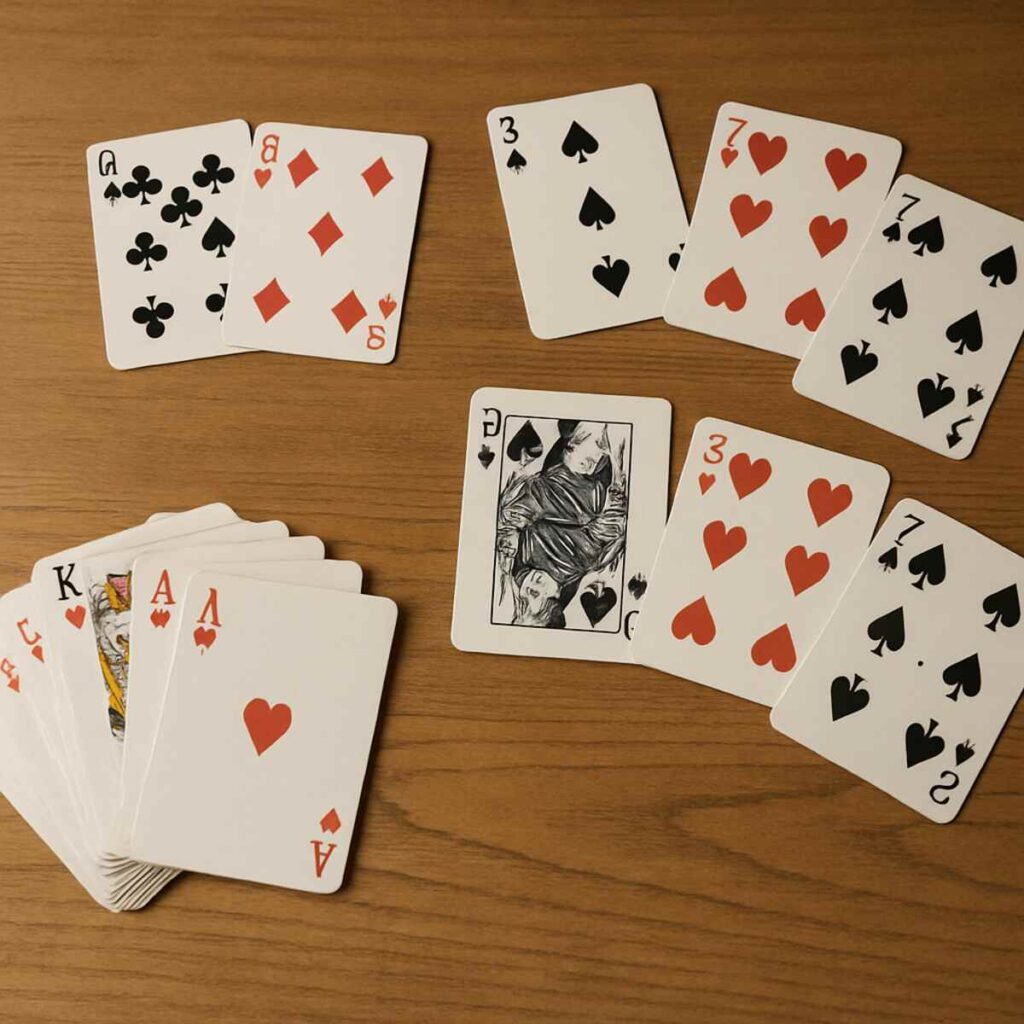
Looking for a new card game for your next get-together—something that’s quick to learn but still leads to plenty of laughs? Meet Nines, a clever and simple game where the rules take five minutes to learn and the main goal is to avoid winning. It’s the perfect answer for anyone who wants an engaging group activity without a complicated setup. Check out UFAC4 to know more
In most card games, you want the highest card. You want to win the round. Nines flips that idea completely on its head. Here, the whole point is to lose cleverly. Each round of play is called a “trick,” and the core objective is to avoid taking them. Getting stuck winning a trick, especially the wrong one, is how you get knocked out of the game.
The best part is how accessible it is. All you need to jump into your first game is one standard 52-card deck and at least two other friends to play with. There’s no complex scoring to track or special equipment required, making it an ideal choice for families, parties, or any casual gathering.
This guide will walk you through everything from the deal to the single most dreaded card in the deck. By the end, you’ll understand not only how to play, but also why its delightful suspense makes it an instant favorite.
What You Need and How to Set Up in Under a Minute
Getting a game of Nines started is incredibly fast, which is a big part of its charm. You just need one standard 52-card deck (no jokers) and between three to five players. This player count keeps the game moving and makes every decision feel important, so it’s perfect for a small gathering.
Once you have your group, the next step is the deal. The dealer distributes the entire deck using these simple steps:
- Shuffle the deck well.
- Deal the cards face-down, one at a time, to each player.
- Continue dealing around the circle until the deck is empty.
It’s perfectly normal for some players to have one more card than others—this won’t affect the game at all, so don’t worry about making the hands perfectly even.
That’s it! There is no draw pile or discard pile to start. Everyone simply picks up their hand of cards and is ready to play.
How a “Trick” Works: The Core of Nines Gameplay
The game of Nines is played in a series of mini-rounds called “tricks.” A trick is simply one round where every player, moving clockwise, plays a single card from their hand into the center of the table. The person to the left of the dealer starts the very first trick by choosing any card from their hand and playing it face-up. This is known as leading a trick.
After the first card is played, the turn moves to the next player, who adds their own card, and so on around the circle until everyone has contributed one card. This collection of cards now sitting in the middle of the table makes up the trick.
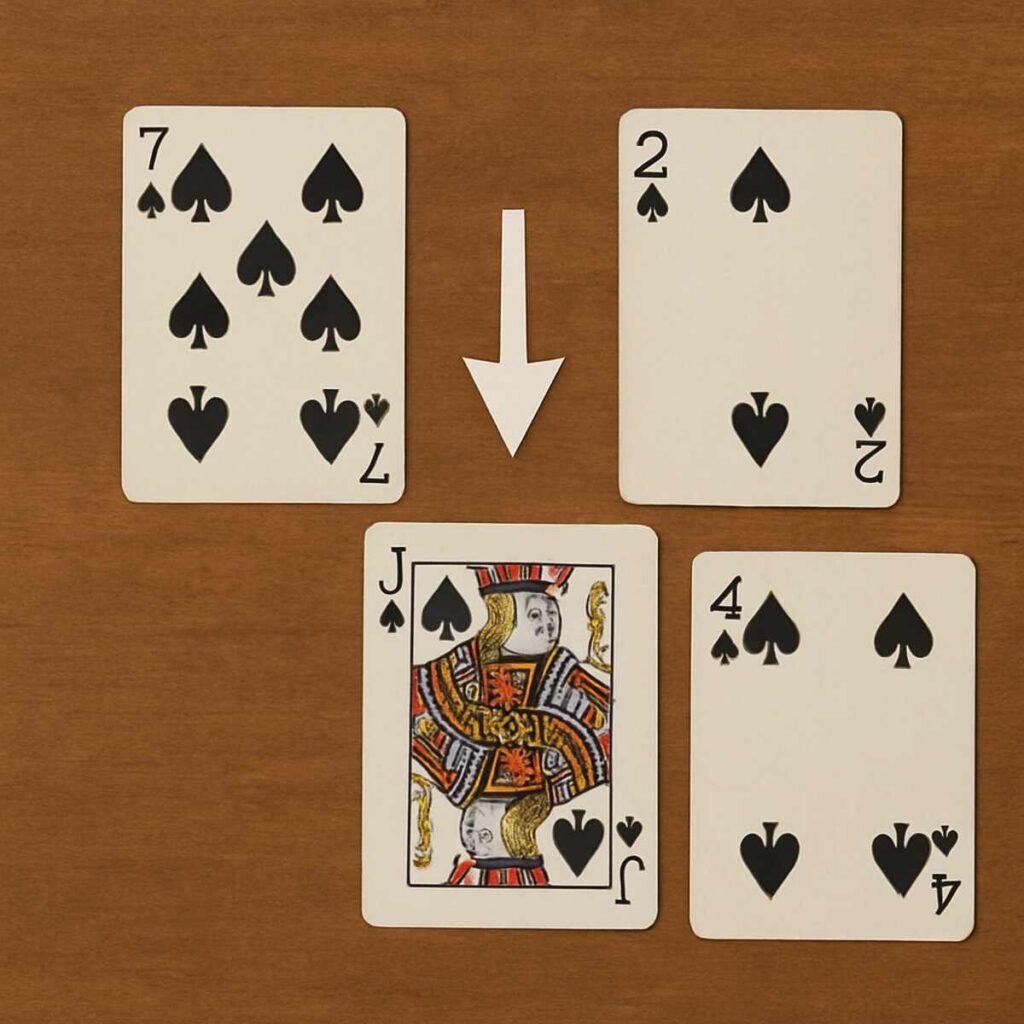
Determining the winner is straightforward. The player who played the highest-ranking card of the suit that was led wins the trick. For example, if the first player leads with a 7 of Spades, and the other players contribute the 2 of Spades, Jack of Spades, and 4 of Spades, the person who played the Jack of Spades wins. (Card ranks are standard, with Ace as the highest). The winner takes all the cards from that trick and places them face-down in a personal pile.
Now, here’s the twist that makes Nines so interesting: winning a trick isn’t always a good thing. The winner of a trick has one crucial responsibility: they must lead the card for the next trick. This gives them control, but as you’ll see, it can also force them into a dangerous spot.
The Most Important Rule: You Must “Follow Suit”
That responsibility of leading the next trick brings us to the central rule of Nines, a concept known as “following suit.” This rule dictates what card you are allowed to play during any given trick, and it’s the key to the whole game.
Simply put, following suit means that if you have a card in your hand that matches the suit of the first card led in a trick, you must play a card of that suit. It doesn’t matter if your card is higher or lower than the lead card; as long as the suit matches, it’s a legal play.
For instance, imagine the player before you leads with the 4 of Diamonds. You look at your hand and see you have the 2 of Diamonds and the King of Spades. Because you have a Diamond, the rule requires you to play it. You must play the 2 of Diamonds. You are not allowed to play the King of Spades in this situation.
This rule creates the entire strategy of Nines. It limits your options and can force you to play a high card when you’d rather not, potentially making you win a trick you wanted to avoid. But this raises a crucial question: What happens when you simply don’t have a card of the suit that was led?
What Happens When You Can’t Follow Suit?
Not having a card of the suit that was led is often a blessing in disguise. When it’s your turn and you find you have no cards of the led suit, you gain a powerful freedom: you can play any single card from your hand. This moment is where much of the game’s strategy comes into play, turning a potential weakness into your greatest advantage.
Here’s the crucial part: if you play a card that doesn’t match the led suit, you cannot win the trick. It doesn’t matter how high your card is. For example, if someone leads with a low Club and you have no Clubs, you could play the Ace of Spades. Even though the Ace is a high card, you are disqualified from winning that trick because you didn’t follow suit. The trick will go to whoever played the highest Club.
This opens up a fantastic opportunity to get rid of cards you don’t want. Since you know you can’t win the trick, it’s the perfect time to discard a high-value card—like a King or an Ace—that might otherwise force you to take a trick later on. Using these chances to safely play high cards on another player’s trick is a key defensive move.
This ability to safely discard a problem card is your primary way to avoid tricks you don’t want. And there is one card in particular you will be desperate to get rid of this way—a card so dreaded it can knock you out of the game instantly.
The Dreaded Nine of Hearts: The One Card to Avoid at All Costs
The one dreaded card is the Nine of Hearts. While it looks like any other card, in the game of Nines, it carries a unique and game-ending penalty. You can think of it as the ultimate “hot potato” of the deck; getting stuck with it is the worst possible outcome.
If you are the unlucky player who takes the trick containing the Nine of Hearts, you are immediately eliminated from that round. This is often called “going down” or being “shot.” It doesn’t matter if you had the fewest tricks or were playing perfectly up to that point—capturing that single card knocks you out instantly. This is why avoiding tricks is so critical.
This rule completely changes how you view your hand. A high card in the suit that was led might seem strong, but it could be a trap. For example, imagine a player leads a Diamond. The next player has no Diamonds and discards the Nine of Hearts. If you are last to play and throw down the Ace of Diamonds, you will win the trick—and be eliminated from the game for taking the Nine of Hearts along with it.
Suddenly, the whole game snaps into focus. The objective isn’t just to passively avoid tricks, but to actively look for opportunities to force another player to take the Nine of Hearts. Holding onto it is risky, but getting rid of it at just the right moment on an opponent you know must win the trick is the most powerful move in the game.
How to Win and Keep Score
If winning tricks is risky and taking the Nine of Hearts gets you knocked out, how does anyone actually win? It’s simple: you win a round just by surviving. The last player left standing—the only one who didn’t capture the Nine of Hearts—is declared the winner of that round. Think of it less like a race to a finish line and more like being the last person remaining in a game of dodgeball.
Instead of celebrating wins, the scoring in Nines focuses on tracking losses. The system is incredibly simple: after each round, the player who was eliminated for taking the Nine of Hearts receives one penalty point. Everyone else, including the person who “won” the round by being the last one left, gets zero points. A notepad and pen are all you need to jot down who took the hit.
The entire game concludes when one player reaches a predetermined number of losses—traditionally, nine of them, which is what gives the game its name. At that point, you stop and count up the scores. The player with the lowest total score is crowned the overall champion. It’s entirely possible for someone to win the whole game without ever having won a single round, simply by being the best at avoiding that one fateful card.
Here’s what a scoreboard might look like after three rounds:
- Anna: 1 (took 9♥ in round 2)
- Ben: 0
- You: 2 (took 9♥ in rounds 1 and 3)
Three Basic Strategies to Help You Win
While Nines involves a healthy dose of luck, a few simple strategies can dramatically improve your chances of avoiding penalty points. Keeping these three tips in mind will give you a significant edge.
First, high cards like Aces and Kings are dangerous. In Nines, winning a trick is often a bad thing, so try to get rid of your high cards early. The perfect time to do this is on a trick you know you are going to lose because you can’t follow suit. Tossing a high card onto another player’s winning trick is a safe way to shed a liability.
If you’re unlucky enough to be dealt the Nine of Hearts, don’t panic. Your goal is to hold onto it until you find a safe moment to discard it. Wait for a round where a suit is led that you don’t have in your hand. This is your golden opportunity. When it’s your turn, you can legally play the Nine of Hearts on that trick, knowing you can’t possibly “win” it because your card doesn’t match the leading suit.
Finally, a simple but powerful strategy is to notice which suits have been played frequently. If you’ve seen a lot of Spades go by, it’s likely that some players are now out of them. Leading with a Spade at that point is risky, as anyone who is out of them can use the opportunity to dump an unwanted card—like the Nine of Hearts—on you.
Fun Variations to Spice Up Your Game Night
After a few games, you might be ready to introduce some new twists. These optional variations are perfect for keeping the game fresh and add new layers of strategy without overcomplicating the fun.
A simple way to change the dynamic is to add more penalty cards. In this version, instead of instant elimination, you play for points. The Nine of Hearts is still the most feared card, now worth a whopping 9 penalty points to whoever takes it. To make things even more interesting, each Five you collect in your tricks adds 5 penalty points to your score. At the end of the round, you tally up the points, and the player with the lowest score wins.
For an extra layer of drama, you can designate the Nine of Spades as a “safety” card. In this variation, if a player takes a trick containing the dreaded Nine of Hearts, the Nine of Spades can come to the rescue. If the Nine of Spades is played in the same trick, it cancels out the Nine of Hearts penalty entirely! This adds a thrilling moment of hope and makes the Nine of Spades a surprisingly powerful card to hold.
If you’re playing with just three people, you’ll notice the cards don’t deal evenly. A great rule for 3 players is to simply remove one full suit from the deck before dealing (all 13 Clubs, for example). This leaves 39 cards, which deals a perfect 13-card hand to each player. This not only solves the dealing problem but also makes the game faster and more intense, as players will run out of suits much more quickly.
Your First Game of Nines
You arrived here looking for a new card game, and now you’re ready to lead one. You know that the goal isn’t to win tricks but to avoid them, you understand how to follow suit, and you’re prepared to steer clear of the dreaded Nine of Hearts. You have successfully turned curiosity into capability.
Your only next step is to play. Gather at least two friends, grab a standard deck of cards, and deal a hand. As you play your first game, don’t worry about deep strategy. Instead, focus on the fun of watching everyone try to dodge taking a trick. You’re no longer just playing with cards; you’re playing a delightful game of “hot potato” where losing a round is the best thing you can do. Enjoy the suspense, embrace the simple rules, and have fun being the last one standing.