


Ads promising you can “earn money playing games” are everywhere. Most sound too good to be true, and frankly, they often are. But the core idea of turning your gaming time into actual cash isn’t a complete fantasy. The reality is just more complicated—and riskier—than a 30-second ad will ever admit. For a growing number of games, the line between virtual achievements and your bank account is starting to blur. Check out angkasa189 to know more
Getting paid from a game almost always follows one of two paths. The first is the unofficial route, a digital gray market where players trade items for cash against the game’s rules. The second involves official “real money gaming” systems, where games are specifically built to let players own and sell their digital assets. Understanding the difference is critical, as many players, lured by promises of an easy online game cash withdrawal, walk straight into a scam or get their accounts banned. According to the Federal Trade Commission (FTC), reports of social media scams involving gaming have skyrocketed, costing consumers hundreds of millions. This guide will help you separate the legitimate opportunities from the digital traps.
What’s the Difference Between Game “Gold” and Real Money?
Have you ever wondered if the mountains of digital gold you’ve earned are worth anything outside the game? For most games, the answer is no. Think of standard in-game currency like tickets you win at an arcade. You can exchange them for prizes at that arcade, but you can’t use them to buy groceries. This is a closed-loop economy, where the value is created by the game and is designed to stay within its walls.
However, the exception isn’t the currency itself, but the specific items you can acquire. If a game allows you to transfer a rare sword or a unique costume to another person outside of its own storefront, that item suddenly has the potential for real-world value. The critical factor isn’t how powerful an item is, but whether you can truly give it to someone else.
This ability to trade items has created side-economies run by players, not game developers. On external websites and forums, people have been buying and selling these digital goods for actual money for years. This is the oldest and most common way to “cash out,” but it operates in an unregulated space, often against the game’s rules and filled with risk.
Path 1: The “Gray Market” for Cashing Out Game Items
That risky environment where players sell game items for cash has a name: the gray market. This practice, known as Real Money Trading (RMT), happens on third-party gaming marketplaces that act like an eBay or Craigslist for virtual goods. These websites are not run by the game’s creators. Instead, they are independent platforms where one player can list their rare “Dragon Slayer Axe” for $50, and another can buy it using PayPal.
The process usually involves a middleman service provided by the website. The seller gives the item to a site representative in-game, and the buyer sends money to the website. Once the site confirms it has both the item and the cash, it completes the exchange, delivering the item to the buyer and the money (minus a fee) to the seller. This structure is designed to prevent either person from running off with the other’s property.
So if it works, why is it a “gray” market? Because nearly all major game developers explicitly forbid RMT in their terms of service. They argue it creates unfair advantages, encourages hacking to steal valuable items, and can ruin the game’s economy for everyone else. Participating in this kind of trade means breaking the rules, which puts your account and your money at significant risk.
The Top 3 Dangers of Using Unofficial “Gray Market” Sites
While the idea of turning your digital loot into real cash is tempting, the gray market is full of traps. Is RMT safe? The short answer is no. You’re operating outside the game’s official rules, which means you have no protection when things go wrong.
The most common trap is a simple but effective payment scam. A buyer can pay you, receive your item, and then immediately tell their credit card company or PayPal that the transaction was fraudulent. This is called a chargeback. Because you can’t prove you delivered a “digital sword,” the payment service often sides with the buyer, reverses the payment, and you lose both your item and the money.
Beyond getting scammed by other players, you face two other major RMT risks:
- Permanent Account Bans: Game developers consider RMT cheating. Their systems can often detect unusual trades, and the punishment for violating their Terms of Service (ToS) is severe—usually a permanent ban that erases hundreds of hours of progress.
- Fraudulent Websites: Some gray market sites are nothing more than elaborate schemes to steal your game account login or financial information.
Ultimately, using a gray market is a high-stakes gamble. You are trusting an anonymous buyer and an unregulated website, all while hoping the game’s creators don’t notice. A safer alternative comes from a new model of game design.
Path 2: How “Play-to-Earn” Games Officially Let You Cash Out
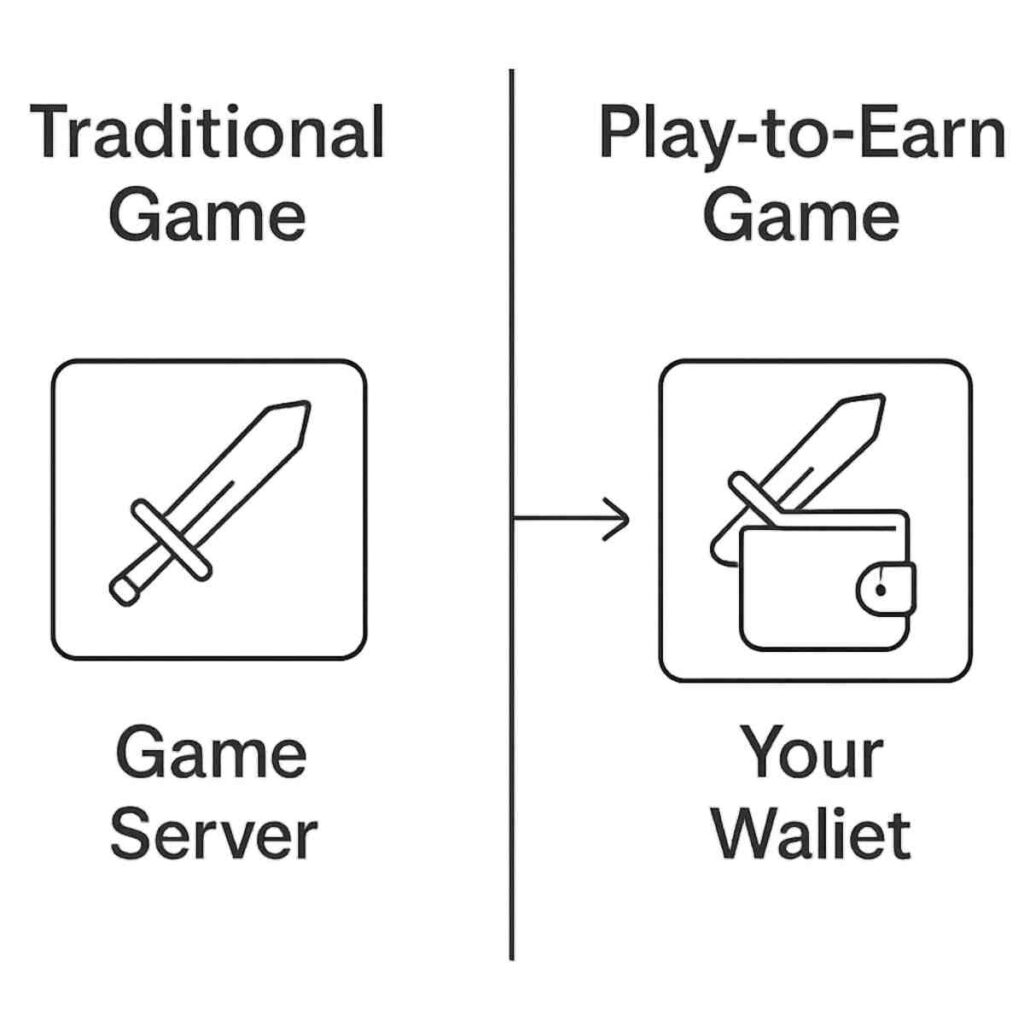
Instead of making cashing out against the rules, a category of “Play-to-Earn” (P2E) games builds the entire experience around it. The key difference isn’t the gameplay, but who truly owns the items you collect. In most games, your gear is just data on a company server; in P2E games, you can actually own your digital items.
This is made possible by NFTs, or Non-Fungible Tokens. Think of an NFT as a digital certificate of ownership for your unique in-game item, like the official title to a car. When you earn an NFT sword, it’s recorded as yours on a public ledger. It exists in your personal digital wallet, not just inside the game’s world. This concept of true digital ownership is the breakthrough that changes everything.
Because you are the verifiable owner, game developers can create official, secure marketplaces for you to sell your items to other players. There’s no risk of a ban because you’re following the rules the game was designed with. The transaction is approved, transparent, and built right into the system. Selling the item, however, is just the first step. You’ll need the right tools to move that value from the game’s marketplace into your bank account.
Your Payout Toolkit: The Most Common Withdrawal Methods Explained
Once you’ve sold your rare digital item on a game’s official marketplace, how do you get that value into your real-world bank account? While some platforms use familiar names like PayPal or direct bank transfers, the modern gaming world often relies on specialized services. The two most important to know are Skrill, an online payment service, and a Crypto Wallet.
For many traditional skill-based gaming sites—where you might win a cash prize from a puzzle tournament—the options will feel familiar. PayPal and direct Bank Transfers are common payout methods because they are secure and trusted. One of the most popular alternatives is Skrill, a digital wallet similar to PayPal but often preferred by international gaming communities for its speed and different fee structure.
For the Play-to-Earn (P2E) games, a Crypto Wallet is usually mandatory. Think of it as a special bank account built to hold digital currencies and your NFT items. It’s the essential bridge for cashing out from these game economies. Here’s a simple summary of each:
- PayPal: Widely accepted and offers excellent user protection.
- Skrill: A popular choice in gaming circles, sometimes with lower fees.
- Bank Transfer: The most direct and secure route to your money.
- Crypto Wallet: Essential for most P2E games; can have the lowest fees.
PayPal vs. Skrill: Which Payout Service is Right for You?
Deciding between PayPal and Skrill for gaming payouts often comes down to fees, especially for smaller amounts. For a $20 withdrawal, a slightly higher fee can noticeably eat into your winnings. PayPal is known for its transparent but sometimes higher currency conversion fees, while Skrill can be more cost-effective for frequent, smaller international transfers.
Your physical location—and the game company’s—also plays a big role. While PayPal has a massive global footprint, Skrill has a strong niche in regions where PayPal might have restrictions. You might find a European game platform that only pays out via Skrill, or a U.S.-based site that only uses PayPal. The best choice is often the one most easily available to you both.
When it comes to safety, PayPal is famous for its Purchase Protection, but this is designed more for buyers of physical goods. As a seller of a virtual item, you may not be fully covered. Skrill, having built its business around the gaming world, often has policies more accustomed to these transfers. Still, always read the fine print, as neither offers foolproof protection against scams.
The Crypto Wallet Crash Course for Gamers
While services like PayPal are built for cash, many modern play-to-earn games require a crypto wallet. Think of it as a secure digital app on your phone or browser that holds your unique in-game items (NFTs) and any cryptocurrency you earn. It’s a personal inventory that belongs to you, not the game company.
Getting started is simple. You’ll download a trusted app like MetaMask or Coinbase Wallet. During setup, you will be given a Secret Recovery Phrase—a unique list of 12 random words. This is not just another password; it is the one and only master key to your digital assets. Write it down and store it somewhere safe and offline, because not even the company that makes the wallet can recover it for you.
Unlike a normal account, there is no “Forgot Password?” link. If you lose the phrase, your assets are gone forever. More importantly, if you ever share it with anyone—even someone pretending to be from customer support—they can gain complete access and empty your wallet instantly. Learning to securely store your crypto starts and ends with never sharing this phrase.
Why Do Gaming Sites Need My ID? The Verification Process Explained
After connecting your wallet, you might hit a roadblock: the site wants a photo of your driver’s license. This gaming payout verification process can feel invasive, but it’s a legal requirement for legitimate companies. Just like a bank must verify your identity before opening an account, gaming platforms do the same to prevent fraud and follow global financial regulations. This formal process is known as “Know Your Customer,” or KYC.
Verification typically involves submitting a clear picture of a government-issued photo ID, such as a driver’s license or passport. Some platforms may also request a recent utility bill to confirm your address. This is the same security standard used in many regulated online spaces, including casinos that offer cash withdrawals.
A platform that invests in this level of security is proving it’s a serious operation, not a scam. You should be more suspicious of a site that lets you withdraw large sums of money without asking questions. Completing this one-time step is a crucial part of being able to securely cash out your gaming winnings.
The Hidden Costs: Understanding Withdrawal Limits and Fees
Seeing your earnings hit $100 is a great feeling, but the amount that lands in your bank account might be less. This is almost always due to platform fees. The gaming site or marketplace often takes a small percentage of your withdrawal as its service charge. Before committing to a game, look for a “Fees” or “Withdrawal” page in its terms to avoid surprises.
The platform fee often isn’t the only cost. The payment service—whether it’s PayPal or a crypto network—usually charges its own transaction fee. These additional fees for withdrawing from gaming accounts are separate from the game’s cut. Your initial $100 might become $95 after the platform fee, and then drop to $92 after the payment processor takes its share.
Beyond fees, platforms also set rules on how much money you can move. You might need to earn at least $10 before you can cash out (a minimum), or you might be capped at withdrawing $500 per month (a maximum). Understanding the withdrawal limits on gaming apps is crucial for managing your expectations, as this system helps platforms manage cash flow securely.
“Is This Taxable?”—What You Need to Know About Gaming Winnings
Are online game winnings taxable? In most countries, including the U.S., the general rule is that income is income, no matter the source. Whether you earned $50 selling a rare in-game sword or from cashing out esports tournament prizes, that money is typically considered taxable income, just like earnings from a side job.
Because this is treated as income, keeping simple records is crucial. You’ll want to track how much you earned and any related costs, like platform fees or in-game purchases you had to make to get those earnings. These expenses can sometimes reduce the amount of income you have to pay taxes on.
This information is for educational purposes and is not financial advice. Tax laws are complex and change based on where you live and how much you earn. For personalized advice, the best step is always to speak with a qualified local tax professional.
Red Flag Checklist: How to Spot a Fake “Cash-Out” Game
While legitimate opportunities exist, the world of instant withdrawal gaming apps is also filled with scams. Before you download a new game that promises easy cash, run it through this quick red flag checklist. Look past the flashy ads and read recent user reviews for words like “payout,” “withdraw,” or “scam.” Real players will almost always share their experiences.
Here are five common warning signs of a fake cash-out game:
- Unrealistic promises: Does it advertise you can earn $100 a day for simple puzzles? If it sounds too good to be true, it is.
- Endless ads to “earn”: The game’s real goal is to make money from you watching ads, not to pay you.
- A fee to unlock withdrawals: You should never have to pay money to access your own earnings. This is a classic scam.
- No customer support: A legitimate app will have a clear way to contact help. If it’s hidden or missing, be suspicious.
- Reviews complain about not getting paid: If dozens of users say they reached the cash-out minimum but never received money, you won’t either.
What to Do When Your Withdrawal Fails
It’s frustrating when you’ve requested a payout and nothing happens. Most online game cash withdrawal problems stem from small, fixable errors. Troubleshooting a failed withdrawal often just takes a few minutes of double-checking your work.
Before contacting support, run through this simple checklist:
- Double-check your details: Is your PayPal email spelled correctly? Is the crypto wallet address exactly right? A single typo is the most common reason for failure.
- Confirm the minimum: Did you meet the platform’s minimum withdrawal amount (e.g., $10)?
- Check your verification: Many services require identity verification before your first cash-out.
- Wait for processing: Payouts are rarely instant. Allow at least 24-48 hours for the transaction to go through.
If you’ve run through those steps and still face payout issues, contact the game’s customer support. When you create a support ticket, be sure to include the Transaction ID. This is the unique tracking number for your withdrawal attempt, usually found in your account’s transaction history. Providing this ID helps the support team resolve the problem much faster.
Your Action Plan for Safe Gaming Withdrawals
The ability to turn gaming achievements into cash is a reality, but it requires careful navigation. The key is to distinguish between high-risk, unofficial gray markets and the sanctioned, safer world of official Play-to-Earn games. Before investing significant time in any game, ask the most important question: “What kind of economy am I entering?”
By identifying whether a game’s value is locked inside a closed loop or has an approved exit ramp, you can make smarter decisions. Vet the platform and its rules to ensure it offers a legal and secure way to earn. Prioritize the security of your account and personal information above all else.
Cashing out gaming winnings isn’t a fantasy, but it’s not a free ATM, either. It’s a frontier that demands caution, research, and a healthy dose of skepticism. With this knowledge, you can better navigate this evolving digital landscape and protect your time and assets.