


Pick up any two cards from that iconic yellow circular tin. Look closely at the assortment of everyday objects printed on them, because between those two randomly selected pieces of cardboard, there is exactly one matching symbol. Not two, not zero—always exactly one. This mathematical guarantee feels like pure magic to anyone experiencing it for the first time, yet it forms the entire foundation of a wildly popular party favorite. To find more, check on somosmiles.org
Inside that little container sits a uniquely designed deck composed of exactly 55 circular cards. Each individual card features eight brightly colored symbols, ranging from a vibrant green dinosaur to a simple block of cheese. While it looks like a chaotic jumble of clip art, every single item is deliberately placed. According to the designers who brought this concept to life, the specific arrangement ensures the ‘One Match’ rule never breaks, no matter how vigorously you shuffle the deck.
We have all faced the dreaded scenario of trying to entertain a restless group with an activity that requires a forty-page manual and an hour of setup. Fortunately, learning how to play spot it rules takes about fifteen seconds and immediately solves that problem. Transforming the tabletop into a frantic visual race, this fast paced symbol matching game strips away turns and waiting, demanding that everyone participate at exactly the same time.
Your only job during this chaos is surprisingly simple: execute the basic “Spot it, Name it, Claim it” mechanic. Players simply find the shared image between their card and the center pile, shout the word out loud, and grab the prize. Since hesitation costs you the round, the gameplay generates infectious energy and usually leaves families laughing until their throats are sore.
Can you spot that single match faster than an eight-year-old sitting across the table? Interestingly, common knowledge among seasoned players dictates that adults actually struggle more at first because our brains overcomplicate the visual processing. Performing a quick visual scan is trickier than it sounds since the matching images rarely share the same proportions. A massive purple cat on your hand might pair perfectly with a tiny, upside-down purple cat buried in the corner of the center card.
Think of dobble the game like a perfectly tuned engine hidden beneath a brightly painted hood. A mathematician used a specific geometric formula to lock that single match into place across the entire dobble game system, but you certainly do not need a degree in combinatorics to enjoy the ride. This foundational trick means you can stop frantically searching every inch of the cardboard and start training your eyes to win.
Decoding the 55-Card Deck: Symbols, Sizes, and Brain-Teasing Layouts
Count how many symbols on each card—you’ll find exactly eight. Since every pair shares exactly one match, finding the duplicate should be instant. Yet, the game’s creators use a clever trick called symbol scaling to slow your brain down. A giant green dinosaur on your card might pair with a microscopic one on the table. Our eyes naturally seek identical copies, making this extreme size variation a brilliantly frustrating roadblock.
Beyond shrinking and growing, these pictures also leverage orientation bias, meaning they are spun in all random directions. If your brain expects an upside-down snowman, it might entirely skip over a right-side-up one. As one of the top visual perception board games for kids and adults alike, it actively forces players to overcome these mental hurdles. The secret to speed is learning to ignore rotation entirely and focus only on the core shape.
To master rapid symbol matching, try a popular pro-tip: scan by color first rather than form. Hunting for a quick flash of purple cuts right through the chaos of jumbled, mismatched-sized images. Once you train your eyes to identify these disguised links, you are ready to compete. These visual shortcuts provide the perfect foundation for mastering the game’s most popular competitive modes.
Mastering ‘The Tower’: The Most Popular Way to Play Dobble
While the core spotting mechanic never changes, the rulebook provides instructions for various mini-game modes to keep gameplay fresh. The absolute favorite in this Asmodee card game collection is “The Tower.” Setup takes mere seconds:
- Deal cards: Give one face-down card to each player.
- Place center pile: Stack the remaining deck face-up in the middle.
- The Flip: Everyone flips their card simultaneously to start the chaos.
Winning this rapid-fire visual race requires strategic eye positioning. Instead of bouncing your focus back and forth, keep your gaze locked dead center on the main stack while using peripheral vision to scan your personal card. Once you shout the match, grab the center card and drop it onto your pile. The real trick is to never look down during this physical transfer. Because your newly won card instantly becomes your active playing card, your eyes should already be hunting for its match on the freshly exposed center card before you even let go.
As the central stack shrinks, you inevitably hit the heart-pounding final card scramble. To secure that ultimate victory, keep your hand hovering lightly above the table, ready to snatch the prize the microsecond you vocalize the symbol. It feels like pure mayhem, with hands flying and players laughing in frustration, yet the game’s underlying engine never glitches. Even in this frantic rush, every single pairing works perfectly. That reliable magic is entirely driven by the mathematics of projective planes.
The Secret Math of Projective Planes: Why It Never Fails
Wondering how every single card manages to connect, no matter how aggressively you shuffle the deck? Think of this clever design as a perfectly tuned hidden engine. Instead of randomly placing pictures on cardboard, the creators used the mathematics behind matching symbol cards to build a “Universal Key” system. Every piece acts as a unique lock, sharing exactly one corresponding notch with any other key you pull.
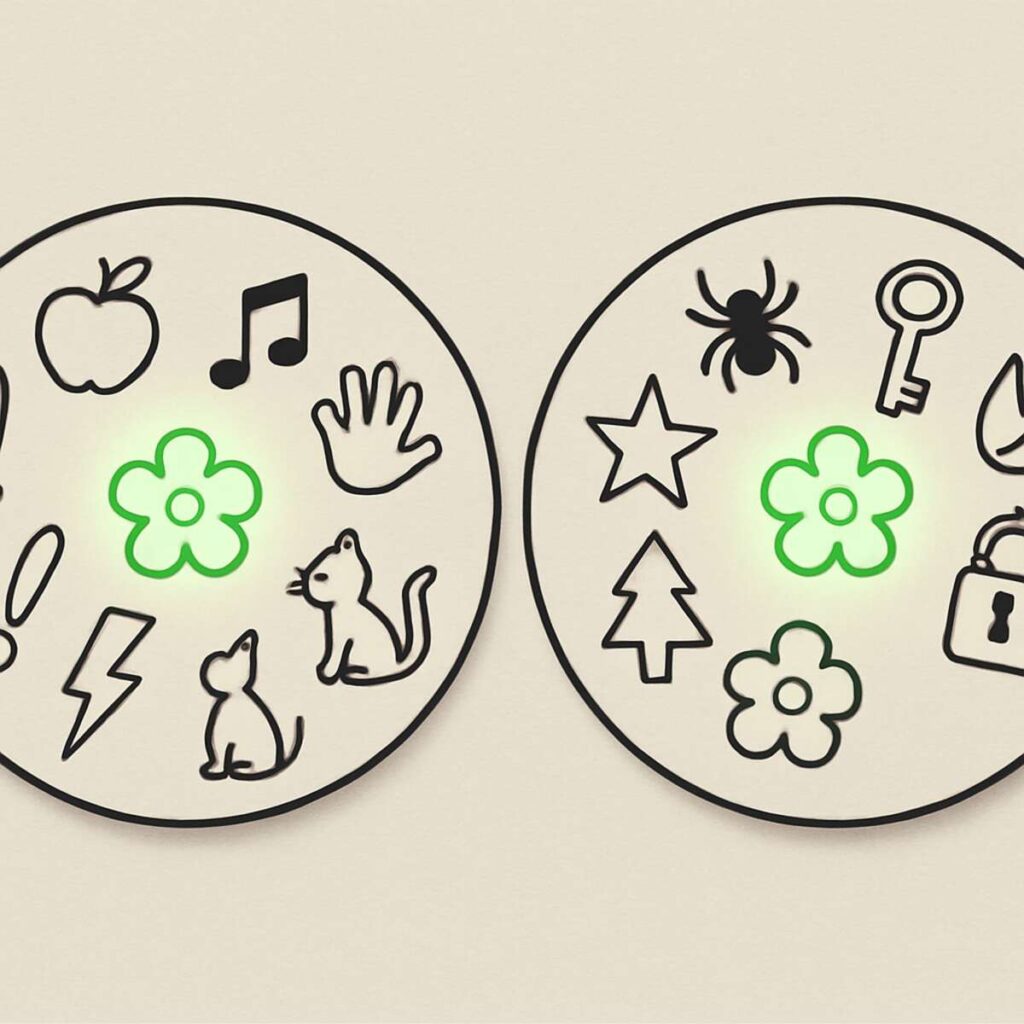
This unbreakable fairness relies on a geometric concept called a finite projective plane. You do not need a math degree to appreciate it; just picture a web of lines where every pair crosses at exactly one specific dot. Applying this structural blueprint to a game with eight symbols per card dictates a mathematically perfect set of 57 unique combinations. However, the standard commercial tin only contains 55 cards. The manufacturer opted to drop two cards simply to fit standard printing sheets, knowing the magical “one-match” rule would still function flawlessly even with a slightly reduced deck.
Because an invisible net connects everything, gameplay stays perfectly balanced for all players. Nobody ever draws a dead hand without a match, guaranteeing that the frantic fun relies entirely on your visual processing speed rather than random luck. That underlying logic never breaks down, whether you are battling at the dining table or taking the deck camping.
Original vs. Waterproof: Choosing the Right Version for Your Lifestyle
We’ve all felt that panic when a spilled drink threatens a favorite game. While the classic cardboard tin is a living room staple, recognizing the differences between original and waterproof versions saves your deck from a soggy demise. The waterproof edition swaps standard cardstock for thin, flexible plastic, transforming the deck into a nearly indestructible travel companion.
When stocking up on portable travel games for family vacations, weighing these specific trade-offs helps you pick the right set:
- Environment: The original shines indoors, whereas the plastic edition easily survives beach sand, poolside splashes, and sticky camping picnic tables.
- Texture: Standard cards offer a slight paper grip for easy shuffling. Waterproof cards are slicker and slide more in your hands, but they wipe clean instantly.
- Durability and Price: The beach edition costs slightly more upfront, but the plastic material will not fray or warp over time, offering a much longer lifespan for messy households.
Regardless of which material you ultimately choose, the frantic fun remains identical. Your surroundings might change, but the core challenge of spotting that single shared image never wavers. To truly dominate the table—whether it is covered in wet sand or a fancy dining cloth—you will need to train your eyes to look past the obvious.
Peripheral Vision Hacks: How to Scan Multiple Symbols at Once
Watching a seasoned player snatch up cards feels like a magic trick, but their secret is simply how they use their eyes. Instead of frantically darting your vision from a giant cat to a tiny cactus, try the “Soft Gaze” technique. By fixing your eyes on the absolute center of the card, your brain takes in the entire circular playing area at once. This center point focal technique stops you from wasting milliseconds scanning individual images, instantly widening your field of view to catch matches faster.
Once locked onto that central spot, trust your peripheral symbol recognition by hunting for vibrant color cues rather than detailed shapes. Your brain processes colors much faster than complex outlines. Spotting a blurry flash of orange on your card and matching it to an orange blob in the center pile dramatically cuts down hesitation. This subtle shift can reduce your mental processing time by about 15 percent, making it an incredible tool for developing fast reaction times in children while giving adults a serious competitive edge.
The true beauty of this relaxed approach is how it turns a chaotic scramble into a satisfying, predictable rhythm. Beyond stacking up more wins, players are actively improving hand eye coordination through play as their hands learn to react instantly to those peripheral flashes. With these visual mechanics mastered, you can combine these hacks into a customized strategy.
Building Your Personal Dobble Mastery Plan
You no longer look at that little circular tin and just see a simple deck of cards. You now possess the secret behind its mathematical engine and understand the hidden educational benefits of observation games that happen every time a player races to spot a match. Instead of wondering how to entertain a mixed group of kids and adults, you have a universal key to instant engagement right in your pocket, ready to bypass long rulebook explanations and jump straight into the action.
The true beauty of a dobble card game isn’t found in its clever geometry, but in what happens around the table. When you measure a tabletop experience’s success by its “laughter per minute” rather than its strategic depth, this fast-paced visual race easily outperforms heavy board games. It completely levels the playing field, proving that a sharp-eyed seven-year-old can absolutely demolish a room full of confident adults, creating hilarious memories and demanding immediate rematches.
Before your guests arrive, set yourself up for the perfect game night with a quick checklist: grab your favorite tin, clear a central space so everyone can reach the middle, and make sure drinks are safely out of the “splash zone” from enthusiastic hand-slaps. It really is that simple to prepare for an evening of shouting out shared symbols until your throat is sore from laughing.
Improving your speed simply requires a little focused repetition. Try following this structured practice approach:
- Level 1 (Speed): Focus strictly on playing the classic “Tower” mini-game to train your eye-to-mouth coordination and build initial confidence.
- Level 2 (Accuracy): Pay close attention to how the art changes scale; train your brain to quickly scan for base colors and shapes rather than sizes.
- Level 3 (Variety): Mix it up by introducing the “Well” and “Poisoned Gift” mini-games to challenge your visual processing flexibility.
- Level 4 (Tournament): Host a gathering combining multiple decks and keep a running tally of round winners for friendly competition.
The next time you face a rainy afternoon or a lull at a loud party, pop open a tin and witness the magic firsthand. Start with the simplest mini-game, and once your group is comfortable, push their limits. Here is your final pro-tip: try playing with your personal cards face down, forcing everyone to flip their card simultaneously for a frantic, high-stakes sprint. Try it for yourself, and watch how quickly a perfectly designed deck transforms a quiet room into a roaring success.
