


For over a century, the internal combustion engine and aerospace propulsion systems have relied on a relatively simple concept to generate power: a high-voltage electrical spark ignites a compressed mixture of air and fuel. While the humble spark plug has undergone countless iterations, its fundamental design remains unchanged. However, as global demands for extreme fuel efficiency, lower emissions, and higher performance continue to rise, traditional ignition systems are reaching their absolute physical limits. Select the best 260 watt laser igniter.
Enter the modern laser ignition device. By replacing a physical electrode with a highly focused beam of light, engineers are unlocking thermodynamic efficiencies that were once thought impossible. At the cutting edge of this revolution is the 260 watt laser igniter, a powerhouse of optical engineering designed to vaporize fuel and create the perfect combustion event.
In this comprehensive guide, we will explore exactly how this technology works, the physics behind it, and why the transition to optical ignition is set to change the automotive and aerospace industries forever.
The Limitations of Traditional Spark Plugs
To truly understand the brilliance of a laser ignition system, we first need to look at why the century-old spark plug is finally showing its age.
A traditional spark plug uses two metal electrodes separated by a small gap. An ignition coil sends a high-voltage electrical current down the plug, which arcs across the gap, creating a spark. This spark heats the surrounding air-fuel mixture, initiating a flame kernel that spreads throughout the cylinder.
While reliable, this system has several critical flaws when pushed to the extremes of modern engineering:
- Electrode Degradation: The constant electrical arcing, combined with the extreme heat and pressure of combustion, literally vaporizes microscopic layers of the metal electrodes over time.
- Heat Quenching: Because the spark occurs right next to the cold metal of the spark plug and the cylinder wall, a significant amount of the initial heat energy is absorbed (quenched) by the metal. This makes it harder to ignite leaner fuel mixtures.
- Fixed Location: A spark plug can only ignite the fuel at the very top of the combustion chamber. The flame must then travel a relatively long distance to consume all the fuel, which takes time and reduces efficiency.
- Protrusion Issues: Physical spark plugs must protrude into the cylinder, disrupting the carefully engineered aerodynamics of the air-fuel swirl.
By comparing laser pulses to traditional spark plugs, the advantages of light-based ignition become immediately clear. A laser has no physical parts protruding into the harsh environment of the cylinder. It simply fires a beam of light through a flush-mounted optical window.
This non-intrusive approach is the ultimate key to overcoming electrode wear in high-performance engines. Without electrodes to degrade, a laser igniter theoretically offers a limitless lifespan, maintaining peak performance from the first mile to the millionth.
What is a 260 Watt Laser Igniter?
When we talk about a 260 watt laser igniter, we are referring to a highly specialized optical system capable of delivering 260 watts of average or peak optical power, designed specifically to initiate combustion.
It is important to understand that in laser ignition, power and energy are delivered in incredibly short, intense bursts rather than a continuous beam. A 260W system provides a massive amount of energy that can be compressed into nanosecond or picosecond pulses. This rapid delivery of energy is what allows the laser to strip electrons from the fuel molecules, instantly creating a localized star-like plasma.
Core Components of the System
A complete laser ignition system relies on a symphony of high-tech components working in perfect unison:
- The Pump Source: Typically high-power laser diodes that provide the initial light energy.
- The Gain Medium: The crystal (often Nd:YAG) that amplifies the light.
- The Q-Switch: A mechanism that acts as an optical dam, holding back the light until it reaches maximum intensity, then releasing it in a single, devastatingly powerful pulse.
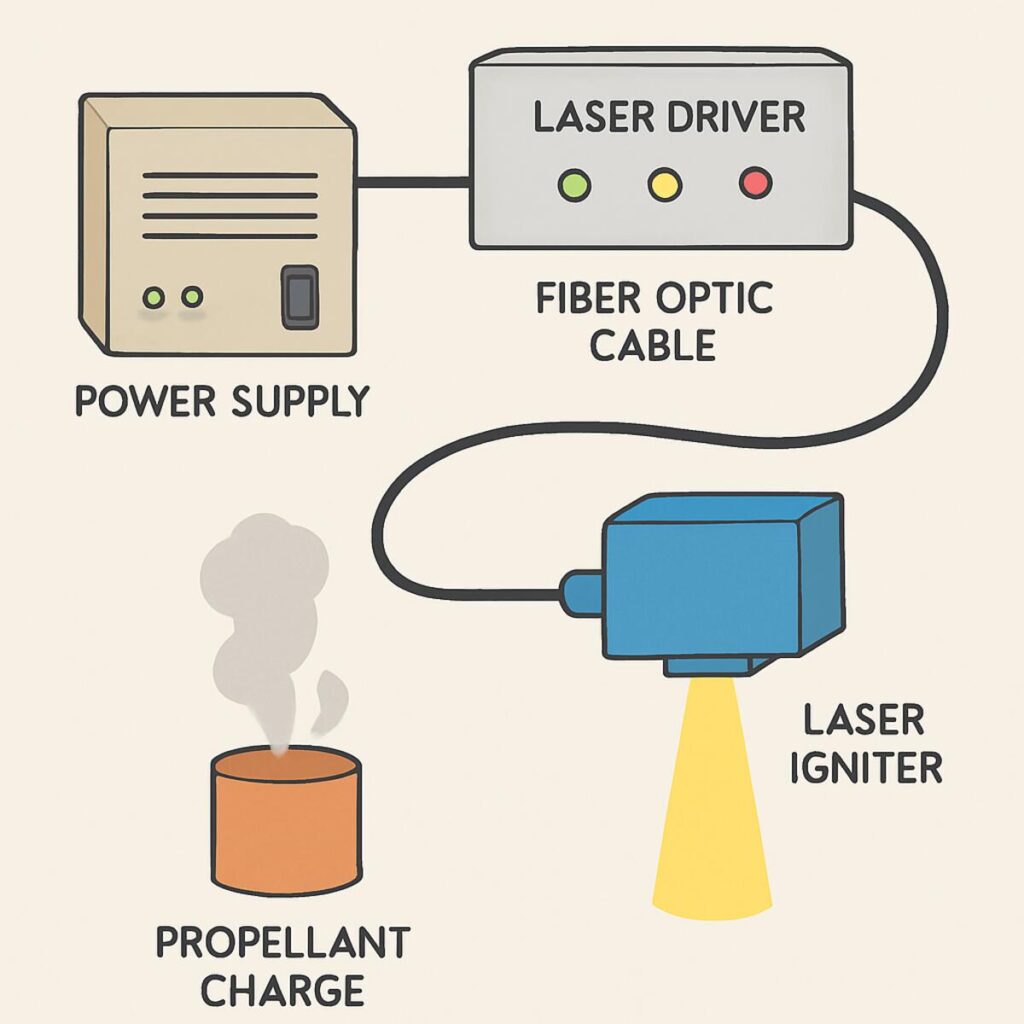
- The Delivery System: Fiber optics or articulated mirrored arms that transport the beam to the engine block.
- The Focusing Optics: Highly specialized lenses that converge the beam into a microscopic point inside the cylinder.
- The Optical Window: A sapphire or quartz window built into the engine block that allows the laser to enter the cylinder while withstanding extreme combustion pressures.
The Physics of Optical Breakdown
So, how does light actually start a fire? You might imagine a laser heating up the fuel like a magnifying glass focusing sunlight on a dry leaf. While that is true for some low-power continuous lasers, a high-power laser ignition device uses a much more violent and instantaneous process.
Step 1: Focusing the Energy
The magic begins with how to focus laser beams for combustion. The laser fires a pulse of light that travels through the optical window and hits a converging lens. This lens takes the wide beam and forcefully narrows it down to a microscopic focal point located deep inside the combustion chamber.
Finding the optimum focal point for fuel ignition is a critical part of engine tuning. Unlike a spark plug, which is fixed at the top of the cylinder, a laser’s focal point can be engineered to occur anywhere in the chamber. By placing the focal point precisely in the center of the cylinder—or in the path of the richest fuel mixture—engineers can ensure the fastest, most even flame spread possible.
Step 2: Dielectric Breakdown
As the 260-watt pulse converges on its focal point, the light intensity becomes staggeringly high. We are talking about gigawatts of peak power per square centimeter, delivered in a billionth of a second.
When the light intensity crosses a specific threshold, it triggers the dielectric breakdown of combustible mixtures. The electromagnetic field of the laser is so strong that it literally rips electrons away from the molecules of the air and fuel.
Step 3: Plasma Formation and Shockwaves
Once the electrons are freed, the gas transitions from a neutral state into an electrically conductive plasma. This rapid transition is the basis of high pressure plasma formation in combustion.
Because this plasma is created in a fraction of a nanosecond, it expands outward at supersonic speeds. This rapid expansion generates a miniature shockwave, which creates a highly turbulent micro-environment. This turbulence physically shreds the surrounding fuel droplets, mixing them aggressively with oxygen and drastically accelerating the combustion process.
The result is a flame kernel that is significantly hotter, faster-growing, and more stable than anything a traditional spark plug could ever hope to produce.
The Laser Technologies Powering the Revolution
Not just any laser can be used to ignite an engine. The environment requires lasers that are robust, compact, and capable of generating incredibly short, intense pulses.
Nd:YAG Lasers: The Industry Standard
The most common and effective crystal used in these systems is the Neodymium-doped Yttrium Aluminum Garnet (Nd:YAG). Using an nd yag laser for fuel initiation has become the gold standard in optical ignition research.
Nd:YAG lasers typically operate at a wavelength of 1064 nanometers, which is in the near-infrared spectrum (invisible to the naked eye). This wavelength is ideal because it transmits easily through fiber optics and sapphire windows with minimal energy loss. Furthermore, Nd:YAG crystals have excellent thermal conductivity, meaning they can fire dozens or even hundreds of times per second without overheating—a strict requirement for high-revving engines.
The Role of Q-Switching
To achieve the massive peak powers required for dielectric breakdown, engineers use q-switched lasers for automotive applications.
Think of a Q-switch like a physical dam holding back a river. As the pump diodes feed energy into the Nd:YAG crystal, the energy builds up. The Q-switch prevents the laser light from escaping, allowing the internal energy to reach staggering levels. When the Q-switch is suddenly “opened” (usually via an electro-optic or acousto-optic modulator), all that stored energy rushes out in a single, massive pulse lasting just a few nanoseconds.
This is why a 260 watt laser igniter can cause such violent plasma formations; that 260 watts of average power is compressed into short bursts of multi-megawatt peak power.
The Advantages of Non-Contact Ignition
The shift from physical electrodes to optical beams brings a host of mechanical and thermodynamic benefits that are reshaping how engineers design internal combustion engines. Let’s break down the major benefits of non-contact ignition systems.
1. Zero Heat Quenching
As mentioned earlier, metal spark plugs absorb the heat of the nascent flame kernel. Because the laser creates its plasma suspended in mid-air, entirely surrounded by combustible fuel and far away from cold metal surfaces, absolutely zero heat is lost. The flame kernel can grow spherically and unobstructed.
2. Variable Ignition Locations
With a laser, the ignition point isn’t tied to the cylinder head. By adjusting the focusing lenses, the laser can ignite the mixture perfectly in the center of the combustion chamber. This reduces the distance the flame front has to travel, speeding up combustion and reducing the likelihood of engine knock (detonation).
3. Infinite Lifespan and No Degradation
Because the optical window is flush with the cylinder wall and no physical parts are exposed to the plasma, there is no electrode to wear down. This reliability is highly sought after in industrial power generation and aerospace applications.
How Optical Sparks Improve Engine Efficiency
The ultimate goal of upgrading to a 260 watt laser igniter is to extract more mechanical work from every drop of fuel. Understanding how optical sparks improve engine efficiency requires looking at the speed and completeness of the burn.
In a traditional engine, the flame spreads relatively slowly from the top of the cylinder downward. By the time the fuel at the bottom of the cylinder is burning, the piston is already moving down, expanding the volume of the chamber and reducing the effective pressure pushing on the piston.
Because a laser spark generates a shockwave and can be focused in the center of the cylinder, the fuel burns much faster. The entire air-fuel mixture is consumed while the piston is still at the very top of its stroke (Top Dead Center). This translates to a massive spike in cylinder pressure right when it matters most, pushing the piston down with far greater force.
Multi-Point Ignition: The Holy Grail of Combustion
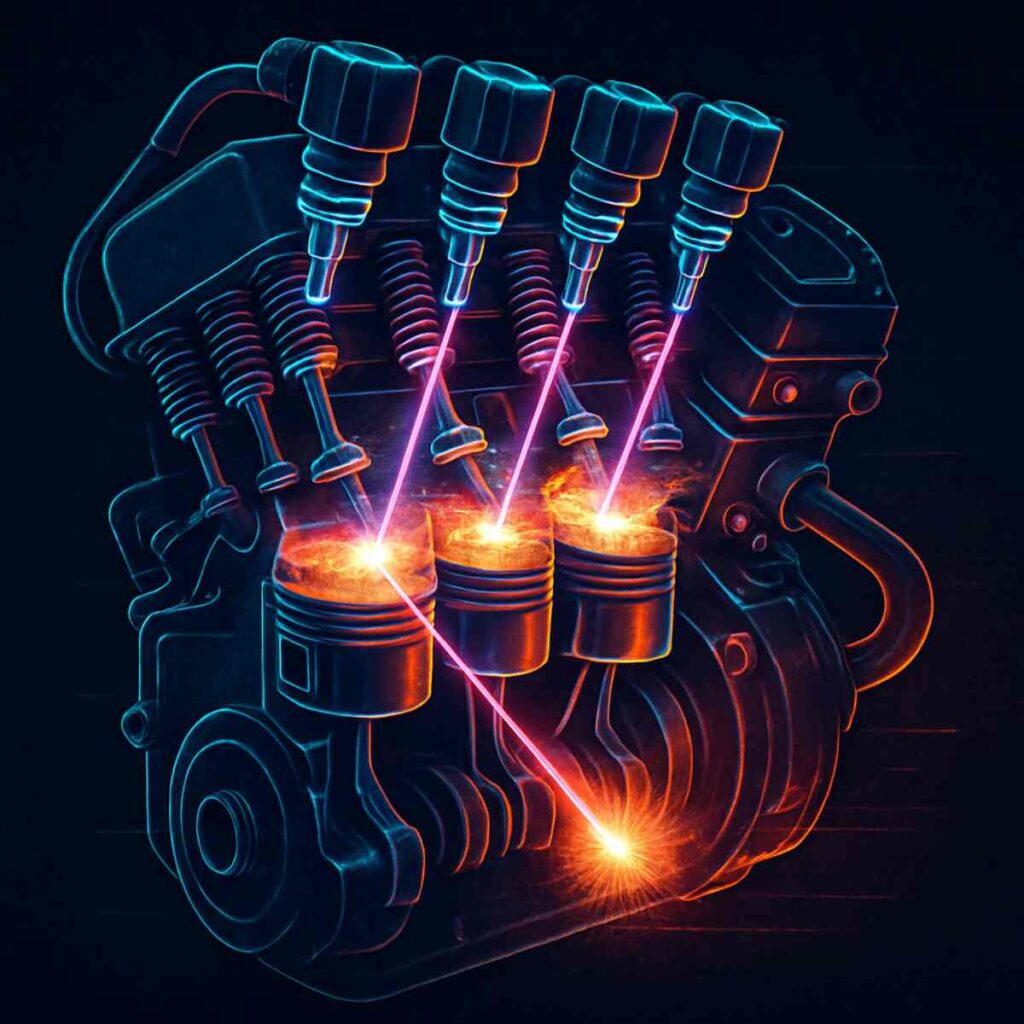
One of the most exciting developments in this field is the concept of multi-point ignition. While a spark plug can only spark in one place, a laser beam can be manipulated to spark in several places at once.
Using specialized diffractive optical elements or spatial light modulators, a single beam from a 260 watt laser igniter can be split into three, four, or even five separate focal points inside the cylinder simultaneously.
The multi-point optical spark advantages are profound. Instead of one flame kernel spreading through the cylinder, you have multiple flame kernels expanding and merging. This drastically reduces the total combustion time. Faster combustion means higher thermal efficiency, more horsepower, and the ability to run higher compression ratios without risking engine knock.
Lean Burn Solutions and Environmental Impact
The automotive and power generation industries are under immense pressure to reduce carbon footprints and meet strict global emissions regulations. This is where laser ignition truly shines.
Igniting the Unignitable
To improve fuel economy, engineers try to run engines “lean.” A lean mixture contains significantly more air and less fuel than the standard stoichiometric ratio (14.7 parts air to 1 part fuel for gasoline).
The problem is that lean mixtures are incredibly difficult to ignite. The fuel molecules are spread so far apart that a traditional spark plug simply doesn’t have the energy—or the spatial reach—to start a self-sustaining flame. The spark happens, but the fire immediately dies out.
Laser based lean burn engine solutions solve this problem entirely. Because the laser delivers a highly intense blast of energy that creates a massive, turbulent plasma shockwave, it can easily ignite ultra-lean mixtures that would cause a standard engine to misfire.
Reducing Greenhouse Gas Emissions
By running ultra-lean air-fuel mixtures, engines consume significantly less fuel, directly resulting in better gas mileage. But the environmental benefits go further.
When an engine runs lean, the overall combustion temperatures are slightly lower. High combustion temperatures are the primary cause of Nitrogen Oxides (NOx), which are harmful greenhouse gases and a major component of smog. By lowering peak combustion temperatures through lean burning, while still ensuring complete fuel combustion via the powerful laser plasma, NOx emissions plummet.
Furthermore, the fast and complete burn provided by the laser ensures that no unburned hydrocarbons (raw fuel) are pushed out of the exhaust. Ultimately, reducing greenhouse gas emissions with laser tech is one of the primary drivers for massive corporate investments into optical ignition research.
Beyond Automotive: Aerospace and Heavy Industries
While the idea of a laser-powered car is exciting, the most immediate and practical applications for the 260 watt laser igniter lie in heavy industries and aerospace, where the budgets are higher, and the demand for absolute reliability is paramount.
Industrial Gas Engines
Large natural gas engines are used worldwide to generate electricity and power industrial facilities. These engines run continuously, 24/7. Spark plug maintenance is a massive operational cost; shutting down a mega-generator to replace worn spark plugs costs thousands of dollars in downtime.
Implementing a laser ignition system in these massive engines allows them to run ultra-lean natural gas mixtures continuously for years without stopping for ignition maintenance, saving industries millions of dollars while slashing emissions.
Aerospace and Rocket Propulsion
The aerospace sector operates in the most extreme environments known to humanity. Igniting fuel in a rocket engine or a jet turbine at high altitudes, where temperatures are freezing and air pressure is incredibly low, is a monumental challenge.
This is where fiber optic delivery in aerospace propulsion becomes a game-changer. Instead of bulky ignition coils and heavy high-voltage wires, engineers can use ultra-lightweight, flexible fiber optic cables to route the laser from a safely housed control unit directly into the combustion chamber of a rocket or jet turbine.
Furthermore, lasers can ignite cryogenic fuels (like liquid hydrogen and liquid oxygen) with incredible precision. The shockwave generated by the plasma ensures instant and reliable ignition, preventing the buildup of unignited rocket fuel in the combustion chamber—a scenario that often leads to catastrophic engine explosions during a rocket’s startup sequence.
Implementation Challenges and Maintenance
Despite the overwhelming advantages, replacing a $5 spark plug with a highly sophisticated optical system is not without its hurdles. Engineers face several practical challenges in bringing laser ignition to the mass market.
Thermal and Vibration Management
Engines are hostile environments. They vibrate violently and generate immense heat. Delicate laser crystals and optical alignment systems traditionally do not fare well under these conditions.
Engineers must design shock-absorbing, thermally isolated housings for the laser diodes and crystals. The use of fiber optics helps immensely here, as the fragile laser generation components can be mounted remotely on the chassis, with only the rugged fiber optic cable and focusing lens mounted directly to the vibrating engine block.
Window Fouling and Cleaning
The most significant hurdle is keeping the optical window clean. If the sapphire window that separates the combustion chamber from the laser lens becomes covered in soot, oil, or carbon deposits, the laser beam will be blocked or scattered, leading to misfires.
Understanding the maintenance requirements for optical igniters usually revolves around this window. Fortunately, engineers have developed clever solutions:
- Self-Cleaning Windows: By focusing a tiny fraction of the laser’s energy onto the surface of the window itself, the laser can instantly vaporize any carbon deposits before they have a chance to build up, effectively creating a self-cleaning system.
- Strategic Placement: Placing the optical window in areas of the cylinder with high air velocity helps “wash” the window with clean intake air during every engine cycle.
Cost and Complexity
Currently, a multi-kilowatt capable Q-switched laser system is exponentially more expensive than an ignition coil and a spark plug. The widespread adoption of the laser ignition device in passenger cars will rely heavily on economies of scale, advancements in cheaper diode technologies, and stricter emissions regulations forcing manufacturers to adopt the technology regardless of initial cost.
Actionable Tips for Engineering Teams and Early Adopters
If you are an engineer, researcher, or mechanic looking toward the future of internal combustion and propulsion, here are a few practical takeaways regarding optical ignition:
- Focus on Window Materials: When designing a test rig, invest heavily in high-grade sapphire for the combustion window. Quartz may be cheaper, but sapphire’s superior thermal conductivity and scratch resistance are necessary for long-term dielectric breakdown testing.
- Optimize the Lean Limit: Don’t just swap a spark plug for a laser and expect massive gains. The true power of the laser is unlocked by heavily modifying the engine’s ECU to run much leaner Air/Fuel ratios (Lambda > 1.5) than traditionally possible.
- Mind the Fiber Bends: If utilizing fiber optic delivery in aerospace propulsion or automotive prototypes, be extremely mindful of the bend radius of the fiber cables. Sharp bends can cause stimulated Brillouin scattering or simple energy leakage, drastically reducing the peak power delivered to the focal point.
- Safety First: A 260 watt laser igniter operating with Q-switched nanosecond pulses can cause instant, permanent blindness if reflected into the eye. Strict Class 4 laser safety protocols, interlocks, and specialized eyewear are non-negotiable in the laboratory.
The Future of the Internal Combustion Engine
While electric vehicles are undoubtedly the future of passenger transport, the internal combustion engine is not disappearing overnight. Heavy-duty transport, maritime shipping, aviation, aerospace, and remote power generation will rely on combustible fuels for decades to come.
For these critical sectors, transitioning to alternative, carbon-neutral fuels like hydrogen, ammonia, or synthetic e-fuels is the path forward. Interestingly, these alternative fuels often possess ignition characteristics that make them notoriously difficult to ignite with standard spark plugs. The laser ignition device is uniquely positioned to be the enabling technology that allows the world’s heavy industries to transition to clean, green fuels smoothly.
Conclusion
The transition from a tiny, localized electrical arc to the violent, shockwave-inducing plasma of a 260 watt laser igniter represents one of the most significant leaps in combustion technology in a century.
By fundamentally changing how we initiate combustion, we unlock a cascade of benefits. The benefits of non-contact ignition systems solve the age-old problem of electrode wear, ensuring infinite lifespans for industrial engines. Mastering the optimum focal point for fuel ignition and utilizing multi-point optical spark advantages allows engines to extract more mechanical energy from less fuel. Most importantly, the ability to implement laser based lean burn engine solutions provides a tangible, immediate path to reducing greenhouse gas emissions with laser tech.
While challenges like cost, vibration management, and the maintenance requirements for optical igniters remain, the pace of optical engineering is moving astonishingly fast. From the depths of massive industrial power plants to the cutting-edge of fiber optic delivery in aerospace propulsion, the spark of the future isn’t electrical—it’s optical.